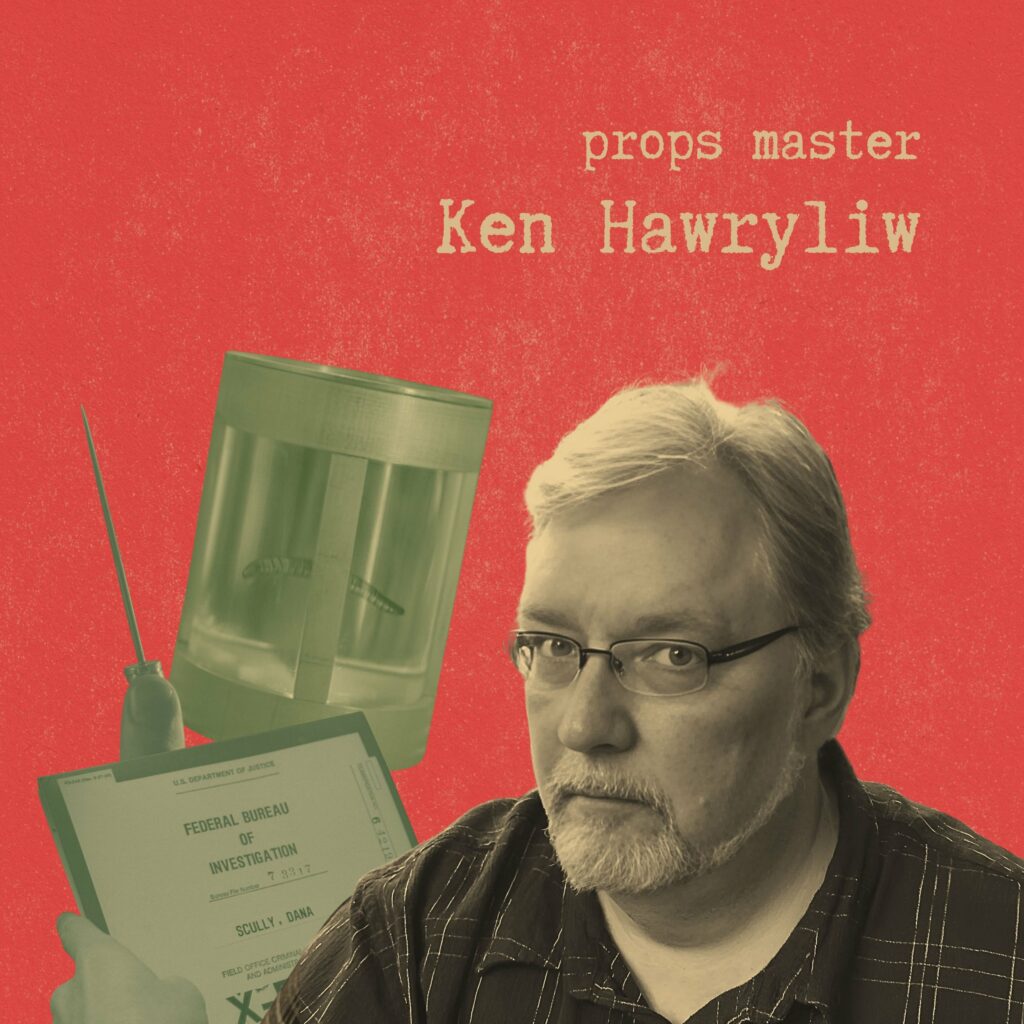
This is a rather recent interview with Ken Hawryliw that I postponed covering because it turned out to be his last interview: Ken died earlier this year. (The GoFundMe fundraiser in his memory is still open.) He was the props master for the first five seasons of The X-Files and season 3 of Millennium (and things like Battlestar Galactica), and I am the proud owner of one of his props.
He had a treasure trove of stories to tell around the making of the shows. The interview ends on an interesting note on how things have changed since the analogue 90s. The interview is from December 2025, from the Hey Danny It’s Mulder podcast. There is some overlap with two other detailed interviews he did not too long ago. Detailed notes follow:
He would have loved to have worked on the pilot, but timing didn’t work out. 1X01: Deep Throat was his first episode. He “got” Chris Carter immediately. They had both seen the very same TV rerun broadcast of “Mysterious Island” when they were young.
He designed a lot of the props: the art department was glad to get this task off their back. He and his team ended up doing a lot of the research, and that meant libraries, phone calls, pre-internet. Over the years he had collected six 6-foot tall bookcases full of books, on topics like forensics. He sold much of that all together for a bookshop that was opening.
They’d develop a relationship with useful contacts, like the head medical examiner of the BC province, military advisors. Starting with 1X08: Space, they had military advisor Ian Fryatt, who got them to use military surplus uniforms correctly; he eventually opened a specialized company on military equipment, Phoenix 1 International Film Services. Then they got Ron Blecker [he has credits on all 1013 series], ex-Black Hawk Down, just two weeks after he left the Army, he wouldn’t say if he had been CIA or not.
They brought people in to make Scully act like a scientist.
In 1X23: The Erlenmeyer Flask: due to the liquid nitrogen, the acrylic fetus neck cracked and snapped off, the head fell on Gillian’s foot, thankfully she didn’t knock over the nitrogen tank. He designed the cradle.
He learned a lot on prop design working with Richard Hudolin [of Stargate SG-1 and Battlestar Galactica fame], and with Harry Lange on “Hyper Sapien” (who had worked on “2001”, “Star Wars”!). Carter wanted props designed from scratch, not take another object and modify it. Film didn’t have the high definition resolution of today, so they had some leeway.
He directed a lot of the insert shots during the first years, which drove the Guild crazy. His first time was for 1X07: Ice, with meal worms.
For the alien stiletto, he knew immediately how it should look like. If it were done with a spring mechanism it would have been twice the size, so they did it pneumatically. The alien artifacts’ look was based on the feel of the Roswell debris, metal fragments, their sheen. For the firewand, Carter told him to make it look like it came from the same factory as the stiletto.
His philosophy was to make it look real. He had the same philosophy in Millennium season 3. He had a reputation as the writers’ Nemesis, correcting them, but it was just to help things be realistic and credible.
Jeanne Lister was their props researcher.
About the 3X18: Teso Dos Bichos funerary urn: Originally it would have been from Uruguay, not Peru. The UN passed a law, you have to get permission to transport human remains across borders. She got hold of the Ambassador to learn what such a letter would look like. It was an urgent phone call, things were lost in translation, the Embassy thought they urgently needed the permit or the shooting would stop.
They got huge cooperation from the military. They got a VIP tour of the USS Constellation, visited the CIC. Story of photos [unclear whether this is for 1X01: Deep Throat or a later episode]: Jeanne was from West Sussex, could seduce people on the phone. She called a Colonel at the Pentagon, they had to know what security and uniforms look like for Edwards Air Force Base. The Colonel dispatched his own photographers to Edwards, back to Pentagon to develop the photos, flew them to the Fed Ex hub in Kentucky because they missed the day’s deadline, so they got them in Vancouver before next morning for the show-and-tell meeting.
For 5X01: Unusual Suspects where he acted: he had a line, “Whatever”. He asked Kim Manners how to say the line, but Vince had written it exactly because that’s what he always said, “Whatever”. Just be yourself.
“Apocalypse Now”: that’s where the CSM was from, and the texture of the print files. Secret files used to be printed on onion skin paper, so they couldn’t be photocopied. They tried to do the same and photocopy them, they burned down their Xerox machine. They had to be typed by hand with old typewriter.
They had two photographers. Ken Staniforth, who has since died, and Marcel [?]. Ken did the art direction of the photo shoots, he had a small crew, to do the crime scene photos. Like with the 3X23: Wetwired photos. It was guaranteed that such photos would be in a close up, because they move the story forward. He had to train the crew that these were important. For the UFO photo in 1X16: E.B.E., they shot the plate, then the art department would do photo retouching.
The case files would be in extreme closeup. The info in them was extremely accurate. This was to help the actors too. Story from Battlestar Galactica: His wife Alison is an author, she wrote a report that Admiral Adama would read. When shooting, Eddie James Olmos stopped the shooting to congratulate the writing, he summoned Ken on set.
Sometimes they would add a little joke in the text. They did it once with Gillian. Clyde Klotz’s nickname was “Dog Boy”. They gave Scully a file to read, and the perpetrator was Clyde “Dog Boy” Klotz, she had a good laugh. They worked long hours, the agenda was to make the best show possible, there were no personalities.
Before 6X17: Trevor: Film director Phil Spink asked Ken to meet Jim Guttridge [a film music composer], who had written a spec script for The X-Files. Ken found it was not quite a TXF script. They thought, why don’t we write one together? They wrote “Remembrance Day”. Carter’s assistant Joanne Service and Vince Gilligan thought it was really good. They got it to Frank Spotnitz; time passed, weeks. Gillian is the only actor with who Ken is friends with, he introduced her to Clyde, he was the first one they told when she got pregnant; so Ken asked her to read the script. In the interim, Ken and Jim wrote another script, just to prove to themselves they could write one in two weeks: it was about the Monkey King, Bigfoot, Stupendous Yappi was in it, it was comedy. Eventually Carter read both, he said to take more time next time. So it became a writing assignment.
Making 6X17: Trevor: It took them 13 pitches to get to Trevor. By season 6 almost everything had been done. The episode’s “beautiful idea” was that this man could do anything except connect with his son. They worked a lot on the scientific part but most was left out. They worked with a theoretical physicist. In an electromagnetic vortex, nobody knows what happens inside. A tornado is like a particle collider. What if you could survive something like that but it would change your molecular structure? It would only work with high-conductivity matter, not for things like glass. If you’d cross something, matter would be charred to its basic molecules, only carbon would remain. The first idea was that Pinker would walk through people and water in their bodies would turn to heavy water, and all cells in their body would rupture, bleed out spontaneously. It wouldn’t fly, too gory, it couldn’t be too sci-fi. The core was that he was propelled by the love for his son. In the first draft they wanted a huge action sequence for the end: Pinker runs through walls of motel rooms. The wind shield idea was taken from what was an earlier scene, where Pinker was stopped by car, and then Mulder figured out the conductivity thing.
Props move the story along, they are like clues. A senior props master who worked in movies like “Legends of the Fall” [Jimmy Chow] used to call him every two months to tell him “you guys are doing amazing work”, it was great to get credit. He is most proud of the attention to detail. At the end of some season, he told Chris “thanks for making me do the best props in my life”, Chris said “we are making television history”.
The only prop from the show he has left is a firestarter wand. There’s a detail that you couldn’t see in the final episode: the handle has a side glass with a liquid fuel gauge.
He’s happy he got to design props. His inspiration is from Richard Hudolin, he’s a child of the 60s, Batman (1966), Irwin Allen shows like Lost in Space and Land of the Giants. , the way prop curves give texture.
John Bartley [TXF director of photography for the first 3 seasons], the first thing he directed was a series pilot with David Hemmings [?], he learned not to use pure white. The directors of photography that came after just tried to “make a Bartley shot”, don’t make it your own. He worked so many hours in the first episodes to get the look right. Studio people asked if they could make production go faster, Bartley said, “hire a different camera man”.
The process to make props has changed a lot: the CNC [Computer Numerical Control] mills, the 3D printing. Things made by human hand had an organic quality. With Harry Lange things had an organic design, which is lost when using keyboards and machines. He’s old school, likes to sculpt, there is no replacement for that. Chris was inspired by “Jason and the Argonauts”, the skeleton fight had a nightmarish quality, you can’t get that with computers. He’s glad TXF was made in an analogue period, it would have been a different show today, way too much CGI. It was the last gasp of analogue times.