I love The X-Files video game! The one with full motion videos from 1998 (aka 3X79: Agrippa). I’m not much of a video game person, but this one recreated the look and feel of the show, and was even a mythology story that fut well with the show’s story in season 3. And not many people know this, but this website got its name from an inside joke from the game.
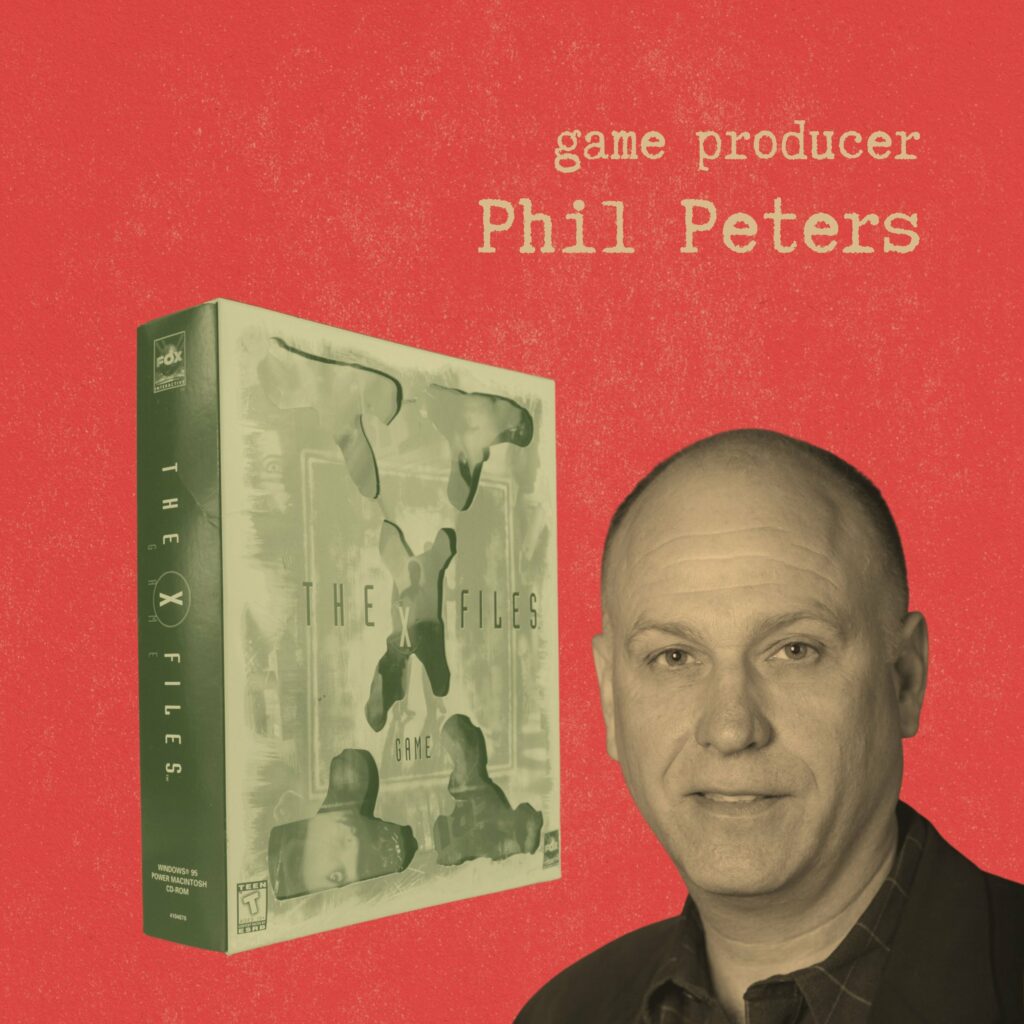
Here is an interview with game producer and production designer Phil Peters, courtesy of the Hey Danny, it’s Mulder podcast!
Peters was involved with the game from the first preproduction meetings to after the release, with the porting to PlayStation 1, alongside the director Greg Roach.
The entire production took 3-4 years. [It’s not clear when it started: the years 1994, 1995 and 1996 are all mentioned. The game was released in 1998, during season 5 and the run-up to the movie. This could explain why the game is set during season 3, which was produced 1995-96.]
He came to game production design after doing costume design for theatre then film production. He had just finished design on Northern Exposure.
First, Hyperbole Studios did a proposal to Chris Carter and Fox studio for a game. They wrote and shot scenes for that. Jordan Williams (Agent Craig Willmore; RIP) was the original lead, a personal friend of his, he was not recast for the final game.
The film world didn’t have knowledge or interest for video games at the time. Everything they did was new.
The only restriction they had was that it had to feel like an extension of the show.
Richard Dowdy, a personal friend of Carter’s, wrote the script, and often came from San Diego, to keep the spirit of the show. [He was not otherwise involved with the show, actually this was his only credit anywhere, so Carter must have trusted him quite a bit. Carter and Spotnitz are credited for the story.]
They were sent all episodes and binge-watched to get to know the show.
The production (coding) and live action photography took place in Seattle. They drove up the 3 hours to Vancouver several times to visit the main series production.
The series’ second unit director of photography, Jon Joffin [seasons 3-4; later DoP for a handful of season 4 episodes, and part of Fight the Future], came from Vancouver and was their DoP, to make sure it would have the same feel.
It was approximately a 30 day shoot.
He made floor plans and figures, like a paper board game, to try to visualise how the gameplay would be like.
The script and related documents was a fat 6 inch binder. [He doesn’t confirm that it was a 750 page document but it must have been something like it.]
Most construction was done in an ex Navy base, Sandpoint naval base. It had huge hangars, they built sets inside. Filming was approached exactly like film or TV. The glass lab (at the end of the game) was built into brig of the navy facility.
The Tarakan ship was at Ballard (Seattle neighborhood), it was an oceangoing tug that had been seized for drug trade between South East Asia and the US West coast!
The motel was a real motel at Mercer Island.
They shot some 6 hours of footage. They had a huge editorial department and a huge spreadsheet to organise.
The game crew were in their 20s. The film crew was more experienced.
In reviews at the time, gamers said it was not interactive enough, while TV fans loved it.
The interactive movie game genre never took off. They were at the cusp of it. The game was on 7 CDs, and studios were already seeing streaming gaming coming up, but it took 5 years.
After other projects in the Seattle area, with the dot com boom, he went into academia, teaching film and documentary in Florida.
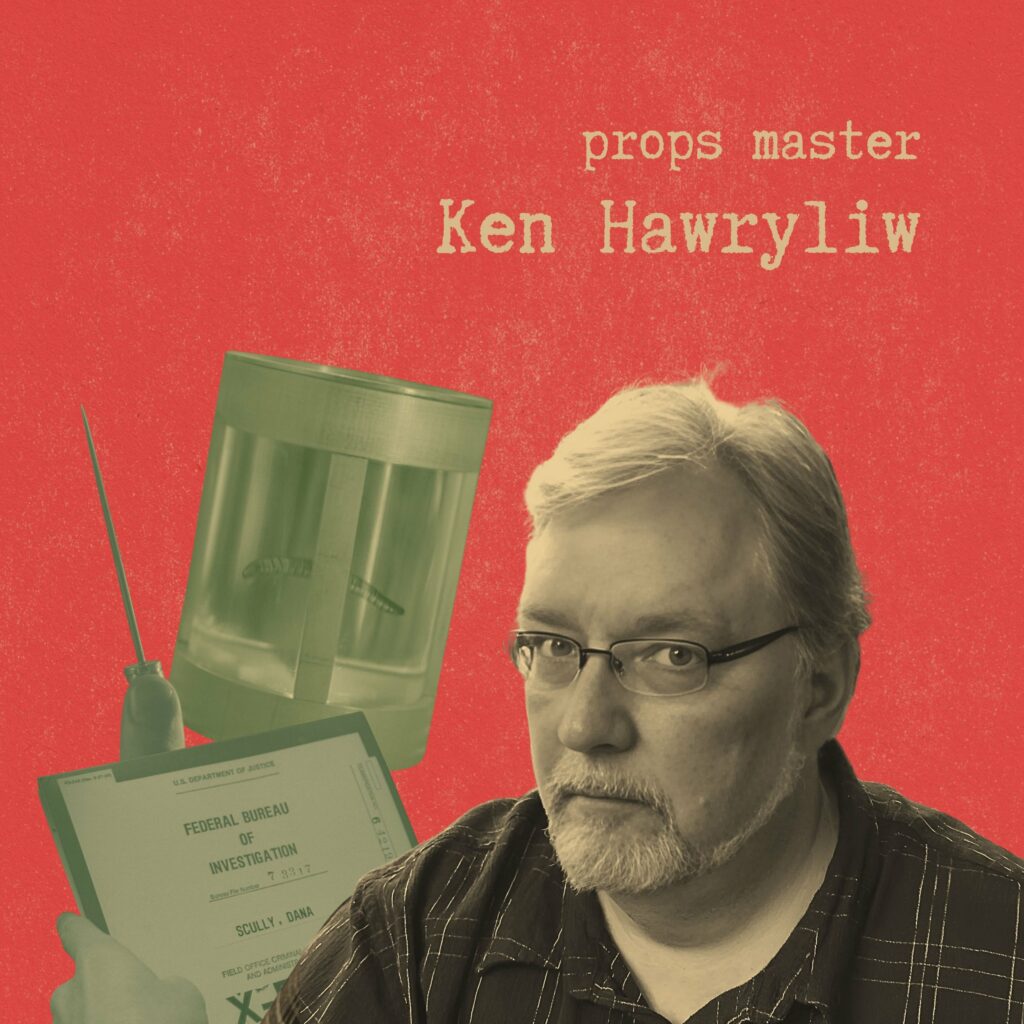
This is a rather recent interview with Ken Hawryliw that I postponed covering because it turned out to be his last interview: Ken died earlier this year. (The GoFundMe fundraiser in his memory is still open.) He was the props master for the first five seasons of The X-Files and season 3 of Millennium (and things like Battlestar Galactica), and I am the proud owner of one of his props.
He had a treasure trove of stories to tell around the making of the shows. The interview ends on an interesting note on how things have changed since the analogue 90s. The interview is from December 2025, from the Hey Danny It’s Mulder podcast. There is some overlap with two otherdetailed interviews he did not too long ago. Detailed notes follow:
He would have loved to have worked on the pilot, but timing didn’t work out. 1X01: Deep Throat was his first episode. He “got” Chris Carter immediately. They had both seen the very same TV rerun broadcast of “Mysterious Island” when they were young.
He designed a lot of the props: the art department was glad to get this task off their back. He and his team ended up doing a lot of the research, and that meant libraries, phone calls, pre-internet. Over the years he had collected six 6-foot tall bookcases full of books, on topics like forensics. He sold much of that all together for a bookshop that was opening.
They’d develop a relationship with useful contacts, like the head medical examiner of the BC province, military advisors. Starting with 1X08: Space, they had military advisor Ian Fryatt, who got them to use military surplus uniforms correctly; he eventually opened a specialized company on military equipment, Phoenix 1 International Film Services. Then they got Ron Blecker [he has credits on all 1013 series], ex-Black Hawk Down, just two weeks after he left the Army, he wouldn’t say if he had been CIA or not.
They brought people in to make Scully act like a scientist.
In 1X23: The Erlenmeyer Flask: due to the liquid nitrogen, the acrylic fetus neck cracked and snapped off, the head fell on Gillian’s foot, thankfully she didn’t knock over the nitrogen tank. He designed the cradle.
He learned a lot on prop design working with Richard Hudolin [of Stargate SG-1 and Battlestar Galactica fame], and with Harry Lange on “Hyper Sapien” (who had worked on “2001”, “Star Wars”!). Carter wanted props designed from scratch, not take another object and modify it. Film didn’t have the high definition resolution of today, so they had some leeway.
He directed a lot of the insert shots during the first years, which drove the Guild crazy. His first time was for 1X07: Ice, with meal worms.
For the alien stiletto, he knew immediately how it should look like. If it were done with a spring mechanism it would have been twice the size, so they did it pneumatically. The alien artifacts’ look was based on the feel of the Roswell debris, metal fragments, their sheen. For the firewand, Carter told him to make it look like it came from the same factory as the stiletto.
His philosophy was to make it look real. He had the same philosophy in Millennium season 3. He had a reputation as the writers’ Nemesis, correcting them, but it was just to help things be realistic and credible.
About the 3X18: Teso Dos Bichos funerary urn: Originally it would have been from Uruguay, not Peru. The UN passed a law, you have to get permission to transport human remains across borders. She got hold of the Ambassador to learn what such a letter would look like. It was an urgent phone call, things were lost in translation, the Embassy thought they urgently needed the permit or the shooting would stop.
They got huge cooperation from the military. They got a VIP tour of the USS Constellation, visited the CIC. Story of photos [unclear whether this is for 1X01: Deep Throat or a later episode]: Jeanne was from West Sussex, could seduce people on the phone. She called a Colonel at the Pentagon, they had to know what security and uniforms look like for Edwards Air Force Base. The Colonel dispatched his own photographers to Edwards, back to Pentagon to develop the photos, flew them to the Fed Ex hub in Kentucky because they missed the day’s deadline, so they got them in Vancouver before next morning for the show-and-tell meeting.
For 5X01: Unusual Suspects where he acted: he had a line, “Whatever”. He asked Kim Manners how to say the line, but Vince had written it exactly because that’s what he always said, “Whatever”. Just be yourself.
“Apocalypse Now”: that’s where the CSM was from, and the texture of the print files. Secret files used to be printed on onion skin paper, so they couldn’t be photocopied. They tried to do the same and photocopy them, they burned down their Xerox machine. They had to be typed by hand with old typewriter.
They had two photographers. Ken Staniforth, who has since died, and Marcel [?]. Ken did the art direction of the photo shoots, he had a small crew, to do the crime scene photos. Like with the 3X23: Wetwired photos. It was guaranteed that such photos would be in a close up, because they move the story forward. He had to train the crew that these were important. For the UFO photo in 1X16: E.B.E., they shot the plate, then the art department would do photo retouching.
The case files would be in extreme closeup. The info in them was extremely accurate. This was to help the actors too. Story from Battlestar Galactica: His wife Alison is an author, she wrote a report that Admiral Adama would read. When shooting, Eddie James Olmos stopped the shooting to congratulate the writing, he summoned Ken on set.
Sometimes they would add a little joke in the text. They did it once with Gillian. Clyde Klotz’s nickname was “Dog Boy”. They gave Scully a file to read, and the perpetrator was Clyde “Dog Boy” Klotz, she had a good laugh. They worked long hours, the agenda was to make the best show possible, there were no personalities.
Before 6X17: Trevor: Film director Phil Spink asked Ken to meet Jim Guttridge [a film music composer], who had written a spec script for The X-Files. Ken found it was not quite a TXF script. They thought, why don’t we write one together? They wrote “Remembrance Day”. Carter’s assistant Joanne Service and Vince Gilligan thought it was really good. They got it to Frank Spotnitz; time passed, weeks. Gillian is the only actor with who Ken is friends with, he introduced her to Clyde, he was the first one they told when she got pregnant; so Ken asked her to read the script. In the interim, Ken and Jim wrote another script, just to prove to themselves they could write one in two weeks: it was about the Monkey King, Bigfoot, Stupendous Yappi was in it, it was comedy. Eventually Carter read both, he said to take more time next time. So it became a writing assignment.
Making 6X17: Trevor: It took them 13 pitches to get to Trevor. By season 6 almost everything had been done. The episode’s “beautiful idea” was that this man could do anything except connect with his son. They worked a lot on the scientific part but most was left out. They worked with a theoretical physicist. In an electromagnetic vortex, nobody knows what happens inside. A tornado is like a particle collider. What if you could survive something like that but it would change your molecular structure? It would only work with high-conductivity matter, not for things like glass. If you’d cross something, matter would be charred to its basic molecules, only carbon would remain. The first idea was that Pinker would walk through people and water in their bodies would turn to heavy water, and all cells in their body would rupture, bleed out spontaneously. It wouldn’t fly, too gory, it couldn’t be too sci-fi. The core was that he was propelled by the love for his son. In the first draft they wanted a huge action sequence for the end: Pinker runs through walls of motel rooms. The wind shield idea was taken from what was an earlier scene, where Pinker was stopped by car, and then Mulder figured out the conductivity thing.
Props move the story along, they are like clues. A senior props master who worked in movies like “Legends of the Fall” [Jimmy Chow] used to call him every two months to tell him “you guys are doing amazing work”, it was great to get credit. He is most proud of the attention to detail. At the end of some season, he told Chris “thanks for making me do the best props in my life”, Chris said “we are making television history”.
The only prop from the show he has left is a firestarter wand. There’s a detail that you couldn’t see in the final episode: the handle has a side glass with a liquid fuel gauge.
He’s happy he got to design props. His inspiration is from Richard Hudolin, he’s a child of the 60s, Batman (1966), Irwin Allen shows like Lost in Space and Land of the Giants. , the way prop curves give texture.
John Bartley [TXF director of photography for the first 3 seasons], the first thing he directed was a series pilot with David Hemmings [?], he learned not to use pure white. The directors of photography that came after just tried to “make a Bartley shot”, don’t make it your own. He worked so many hours in the first episodes to get the look right. Studio people asked if they could make production go faster, Bartley said, “hire a different camera man”.
The process to make props has changed a lot: the CNC [Computer Numerical Control] mills, the 3D printing. Things made by human hand had an organic quality. With Harry Lange things had an organic design, which is lost when using keyboards and machines. He’s old school, likes to sculpt, there is no replacement for that. Chris was inspired by “Jason and the Argonauts”, the skeleton fight had a nightmarish quality, you can’t get that with computers. He’s glad TXF was made in an analogue period, it would have been a different show today, way too much CGI. It was the last gasp of analogue times.
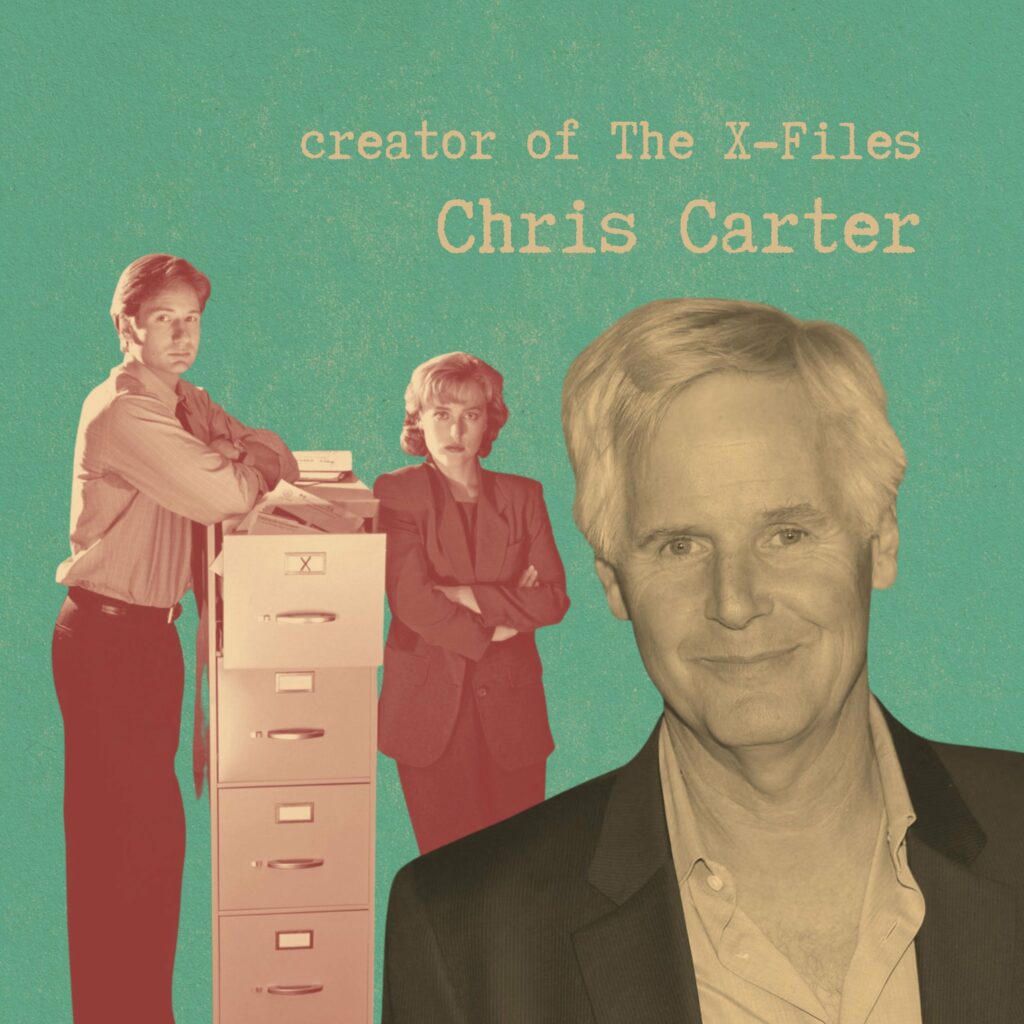
With the “I Want To Believe” Director’s Cut coming out next week, Chris Carter is doing interviews with the active fan podcasts. The main thing that comes out of this is that he is certain that he will be able to continue the show’s mythology and give resolution to his “My Struggles” arc (the word “unappreciated” comes up several times), while he has no involvement with any other project using the X-Files brand (namely, the Coogler reboot).
Here are the details for the interview with the “Hey Danny It’s Mulder” podcast. [My comments are in brackets.]
The My Struggles and the future of the mythology
“I was given a couple of directions when I was asked to reboot the show.” He had to reintroduce the series to new viewers, the characters, their “entanglement”.
[Based on these constraints that were external to Carter, we got much of what fans have been complaining about: a soft-reboot of both the mythology and of the Mulder-Scully relationship. Over the two seasons there is a clear evolution of the MSR, but I can’t say as much about the mythology; hence Carter’s tease that a season 12 would have given answers to the mythology.]
For “My Struggle I” he had gone to a convention on the secret space program. “Mulder’s struggle is weeding through all this conspiracy business.” Tad O’Malley was an Alex Jones-like character. He wrote this in 2015, before the current world where conspiracies are everywhere, this too is “unappreciated”.
[As I wrote in my review, MS1 presents us a world full of wild conspiracies, and I expected that what would follow would be Mulder separating the lies from the truths, finding the truth in all this confusion. Apparently this was Carter’s intention too. However, frankly I don’t see this reflected in the rest of the Struggle episodes at all.]
He met with Frank Spotnitz “subsequent to the series finale”. Frank said “you didn’t give them what they wanted”, Chris replied “what I gave was more than what they wanted, I think that was unappreciated by people.”
[For all my reservations about these episodes (and they are many!), I have to salute the artist in Carter and his strive for something more ambitious than just fan service, meaning not giving us a predictable and by-the-numbers evolution of the mythology or of the MSR but inserting complications. It is these complications that can end up making us more obsessed after all, which is what he means by “more than what they wanted”.]
“I had a bigger idea in mind and it played out through four mythology episodes, I’m hoping we can come back and explore that idea.” “It took four hours to add up to the revelation of the meaning and purpose for all of it, which is two words.” “That will tell you the tale that when TXF returns, and I have no doubt someday it will return in whatever fashion, that will be what we will be exploring.”
[The confidence of the man is amazing! Of course he is trying to generate interest for continuing his story in a self-reinforcing loop. I am ready to believe he has clear ideas for what comes next, but I am not convinced at all that Disney will give him the chance to do it.]
“It really turns into the science fiction show it always promised to be with those two words”, which are the tagline that appears in the beginning of MS4, “Salvator Mundi”. “The CSM’s struggle was that he helped father a child who he calls his own, the damage he did to that child, and how that child who turned a mobile as an infant, had powers that were harnessed and abused, and how he, that character William, will fit into the bigger larger picture of the mythology, and what the unborn child of Mulder and Scully will represent and come to know.”
[On “Salvator Mundi”: this is Lating for “saviour of the world” and is used for Jesus Christ in Renaissance iconography. Time and time again Carter has hinted at the clue that nobody has caught on for what comes next, and I have theorized at length here (and been disproven by Carter!). If the tagline is the clue, then of course many, many fans have thought of this already: it is hard to miss! What does this mean? William is the “saviour of the world”, as prophesied in earlier episodes (7X04: Amor Fati, 9X11: Providence), and in the context of “11X10: My Struggle 4” he did save the world from the CSM’s and the Syndicate’s plan by killing them all. What can come next, and be very science fictional? I can only think of something related to William’s genetics and powers, which might be a precursor to changes in the larger human population, bringing the world closer to a revelation of some kind. Carter had already hinted at something related to the alien genome and about Scully; here he also adds her second child in the mix. All of this sounds very X-Men-like (which is a direction hinted at by episodes like “10X2: Founder’s Mutation“, the Ghouli.net website or even the post-s11 book “Perihelion“. The other thing I can think of is that season 12 would have seen the return of the aliens and their colonization plans, and William’s genetics and powers would play a role in humanity’s fate in this heavenly struggle. Here I am saying all of this when I was already saturated with the religious iconography all the way back in “8X21: Existence”…]
On the mythology and making the series
“So many series that have a mythology, it feels as if they’re winging it. With TXF we really tried to build a perfect house a perfect tower, it has a foundation, structure, artistry, all those things. That’s what made our mythology work, it wasn’t sloppy, it was complicated.” [This is his defense against the widely held view that nothing made sense, a view that is unfortunately still the mainstream even among many fan circles. It is quite ironic how many people would use the same words Carter uses to attack other shows, but they would use them instead to describe TXF’s mythology!]
In the first season, he met at a party a professor who was working on the Human Genome Project. This was the inspiration for his work with Anne Simon on “The Erlenmeyer Flask”.
“The mythology from season 2 on became the work of Frank Spotnitz and myself.”
Critical response impacts him a lot.
On the importance of Scully’s science, he adds: “Science is a spiritual journey, trying to understand God.”
His scientist brother changed in the pilot script the word “time is universal constant” into “invariant”, he was “always there in the background”.
His dad was a fan of Burt Reynolds, working with him was a dream come true (“Improbable”).
He underlines how making the series was a group effort, “everyone combines to make it better”.
On current movies: “Nothing scares me like “The Exorcist” scares me”.
Monica Reyes was originally written as “a flaky character”.
When they left Vancouver, a writer in the LA Times said that TXF is going to fail because it is losing what made its atmosphere. “For me, it was just a new problem to solve.” It was the same for adding the characters of Doggett and Reyes.
Remembering Mark Snow
Before he died, Carter was able to tell Mark Snow that “those six notes would live on” (about TXF main theme).
When Mark did the music for IWTB, he gave Chris a sheet with the inscription “Thanks a million and then some”.
“I always said that we would bring to Mark the finished episode as a corpse and he would breathe life into it.”
On the Coogler project
He spoke with Coogler only once. He hopes his big idea and Coogler’s are “not in competition with one another”. Carter praises Coogler for his past work and the fact that he was awarded and recognized for it. The idea of a TXF project where he is not involved “keeps you on edge”. [It does sound like he is a bit uncomfortable with it all. If Coogler’s project has different lead characters and actors, then how could there be any tension between Coogler’s potential series and Carter’s potential season 12? Only if Coogler’s mythology, instead of focusing on something new altogether, also involves elements that Carter wants to make use of, like the Syndicate’s plans/the aliens/William; or if Coogler plans to involve the characters of Mulder and Scully in a way that would contradict what Carter has in mind. Any of these options sure sound exciting and I hope something out of all this materializes so that we can learn more of them.]
The IWTB Director’s Cut
[The Director’s Cut is coming August 14, a trailer for it has been released with no new footage as far as I can tell.]
Carter was impressed with season 11 editor Eleanor Infante. For “This” she did something not in the script, just with her artistic instinct. For “MS4”, he shot the script in order it was written, and she rearranged it completely, it was “magical”.
“Eleanor is the first person I would go to, it would have been Rob Komatsu but he was busy.” [Rob is another season 10-11 editor]
And so Eleanor was there to “review” the Director’s Cut. [If she was fully involved, then “review” sounds like an understatement.]
The film was cut back due to Fox’s fear it was going to be “torture porn”; then censors further “eviscerated” it.
“It’s a Frankenstein movie.”
Inspiration: he read about a doctor in Cleveland, Ohio who said he successfully transplanted the head of a monkey onto another monkey. He flew there, he had a drink with him and the doctor described him the procedure. What you see in the film is “sort of science fact”. [This was Robert J. White, nicknamed “Dr. Butcher” by animal rights activists, whose crude experiments were done in the 1970s.]
Post credits scene of Mulder and Scully rowing in a boat: They worked in brutal environments, in snow, cold, wind. He wanted to give the characters an escape from that hellish environment.
The new cut is “tighter, scarier”. “It’s essentially the same movie it was, but I think it’s the movie it should have been.” [Let’s see: one week left!]
Queens For A Day
[As revealed here on Eat The Corn, Carter and wife Dori have finished shooting a feature film in Vancouver earlier this year!] It is “unlike anything I’ve ever done”. It is unlike TXF, except for one science fiction element. it features 102 Canadian actors. When he first met again Craig Wrobleski for this movie (the director of photography for TXF season 11), he bought him Rick Rubin’s book on art for him, and Craig was going to get him same book. He is working with a Tracy Temple (Temple? Trebble? Trouble?) for the movie’s music, she is a “terrific composer”. Chris and Dori are going to hit the festival circuit with the movie. [I have no idea what this is, but I really hope they make it all the way to finishing it and finding a distributor. It looks like post-production is quite advanced already.]
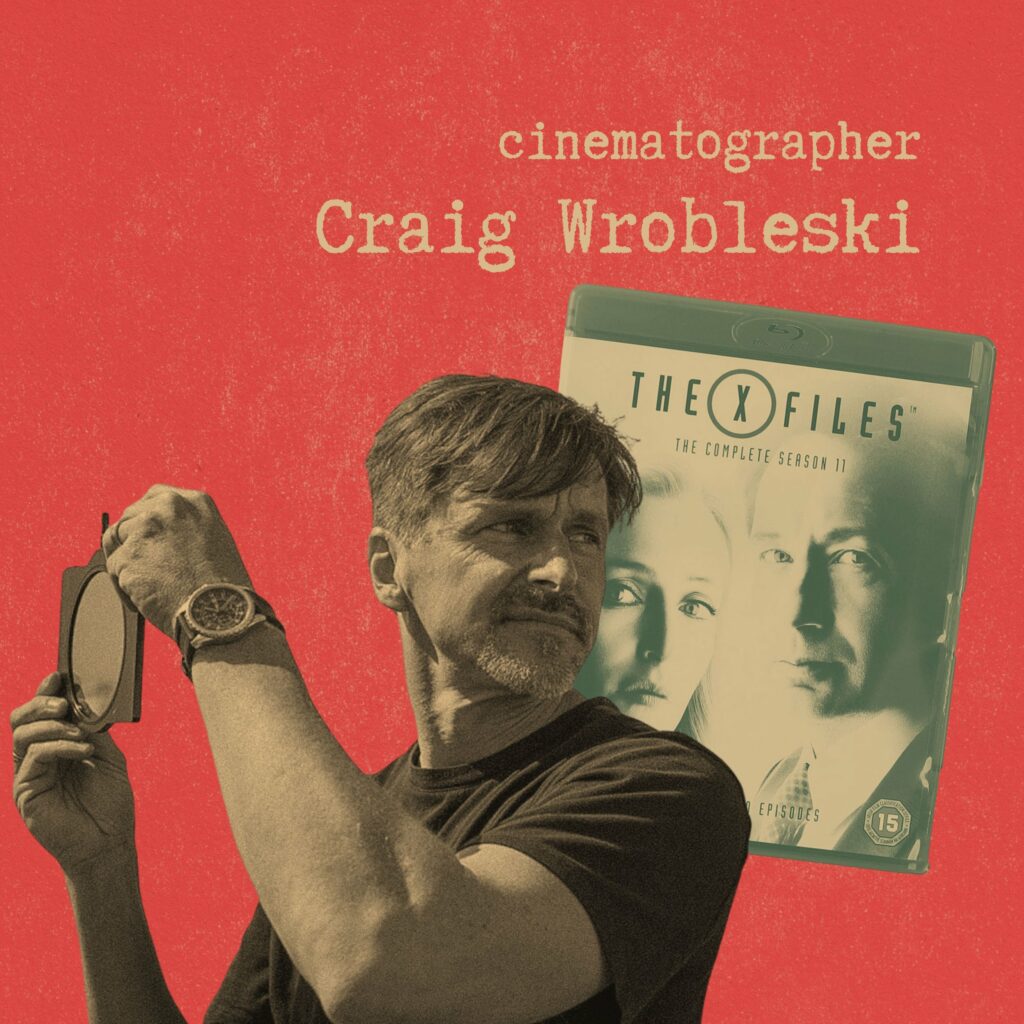
New interview: “Hey Danny It’s Mulder” sat down with Craig Wrobleski, the director of photography for The X-Files season 11, taking over from Joel Ransom in s10, a Canadian who among other things worked on “Fargo” and followed up TXF with some episodes of “The Twilight Zone”. Cinematography is of course one of the most important parts of what made TXF a success, so all eyes were on the DoPs for the revival seasons. After the frankly disappointing look of s10 (surprising from Joel Ransom, who had also worked on s4-5, but on film, not digital), s11 was a distinct step in the right direction. The interview has plenty of technical aspects, very interesting for the details-oriented fan, but there’s much more than that here, about art and the process of creation. Here are my notes from the interview.
In preparation, he read “American Cinematographer” articles written about the show. He watched the episodes shot in Vancouver and those shot in LA: the look changed but it retained the show’s essence. [ASC article example: Joel Ransom]
His approach was not to try to recreate how the show looked back then but retain echoes of it. Vancouver looks much more modern than it looked back then, so a recreation was out of the question. Digital means a different look too.
He likes using shorter lenses to be close to actors, to be closer to the story, be more immersive, to have the supernatural elements but have them be more relatable.
Every script was very descriptive, it told you what the tone should be.
There was a lot of exteriors shooting. They used the TXF office set to shoot just for two days out of the entire season.
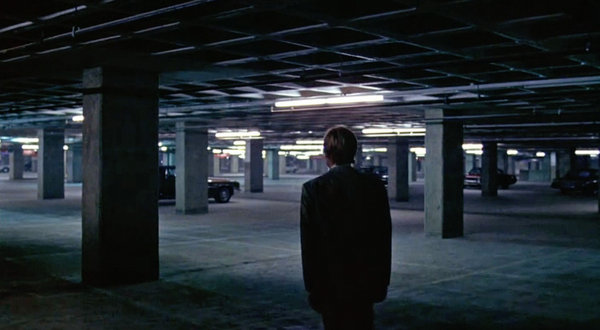
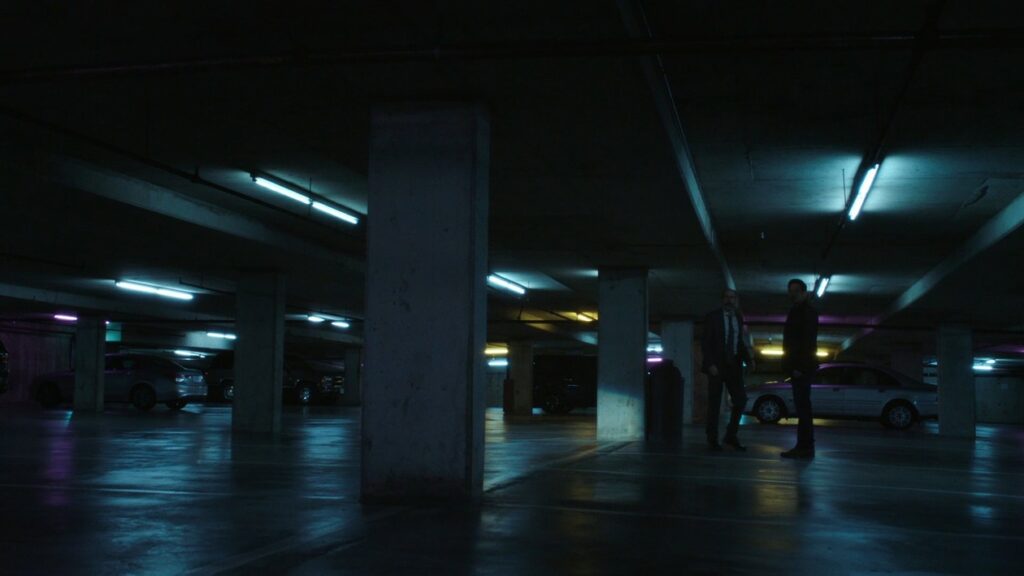
“Lost Art”: the reference for the parking scenes were the parking sequences of “All the President’s Men”, but they didn’t want to recreate it exactly. They used very contemporary cinematography (soft light, shallow depth of field), an old vibe but with a modern aesthetic. The ground surface was coated with a reflective material, an oil of some kind. The lightbulbs were changed. They shot it at a lower temperature at the camera to make it look cooler. They put pink fluorescent lights in the background, in a specific callback to “All the President’s Men”. [That movie was of course a big inspiration on the entire look of TXF, but even more so for these scenes, to a comical degree. Here are some image comparisons, with ATPM first, TXF second.]
“Followers” was all about technology, they wanted it to be like a different world. Scully’s house was a modern rich space, Mulder’s farm house was simple. Note: he says “David”, not “Mulder”, about the ad-libbed line of her house being better than his.
Digital affords to use more colour, they used colour a lot in s11, unlike in s10. [Rather than colour, what I noticed was a better use of darkness and of contrast, which approximated the look of film better compared to the much more digital look of s10.]
He works side by side with the directors. Most shows have alternating directors of photography across episodes, whereas he did all episodes. He didn’t have enough preparation time with the directors. Glen and Chris kept people up to speed. He stopped dreaming during the shoot. He realized he had no spare time for his subconscious to digest what was happening. But creativity works when you let things stew in your mind. [This is interesting — it was a challenging shoot that had its positives but also some negatives.]
His main task is capturing performances. When performance, lighting, lens, camera move, everything happens in the shot, when that happens it’s magic captured in a bottle. Chris is especially sensitive to performance. After a good take, he would give little notes, and the next take would be much better, “The One”.
Digital can make things too polished, sleek, unreal. He wanted things to look natural, real, have soul, patina, have imperfections. Chris is very clear that TXF is not a sci-fi show. It shouldn’t have the clean polished silver polished look of a sci-fi show, it should feel real and relatable.
He asked Chris what brought the show to Vancouver originally: it was the forests. It was “bizarre” when the show moved to LA. In Vancouver, the air is thick, it rains a lot, there are plenty of reflections and sheens, the sky has a low ceiling, gives the feeling of an oppressive environment.
All other crew members in s11 had a connection with the show, even if it was just for s10, except for him.
The last scene they shot was the last scene of the last episode, and the last shot was that final wide shot with the drone pull back.
The Alexa camera has a low contrast curve setting. They shot the season with it. That was a setting unlike the TXF look, it gives a sleek modern look with smooth contrast, but they built contrast in with the lighting and finessed it in the grading process.
Many choices were done not based on logic but on feeling, testing things.
“Lost Art”: the black and white opening scene in the Ovaltine cafe was not shot with a b&w camera, but with a red monochrome camera, which sees more gradations of b&w. After they started shooting, they realized they couldn’t use a blue screen for the special effects, for the mirror shots.
Darin was laughing all the time during the shoot, they could even hear him on the audio recording.
The whole season was like a homage to the legacy of TXF.
For the two-wheeled scooter, Darin just had the idea during a break, “how about we shoot it?” It was so stupid that they had to do it.
“Kitten”: you like to have first shot actually done within the first hour of the shoot day. For the Vietnam sequences with the helicopter, they didn’t start before 5 hours due to the logistics. They were committed to do real shots, not use CGI. That’s crazy for television.
He had a lot of fun on set, it was great experience.
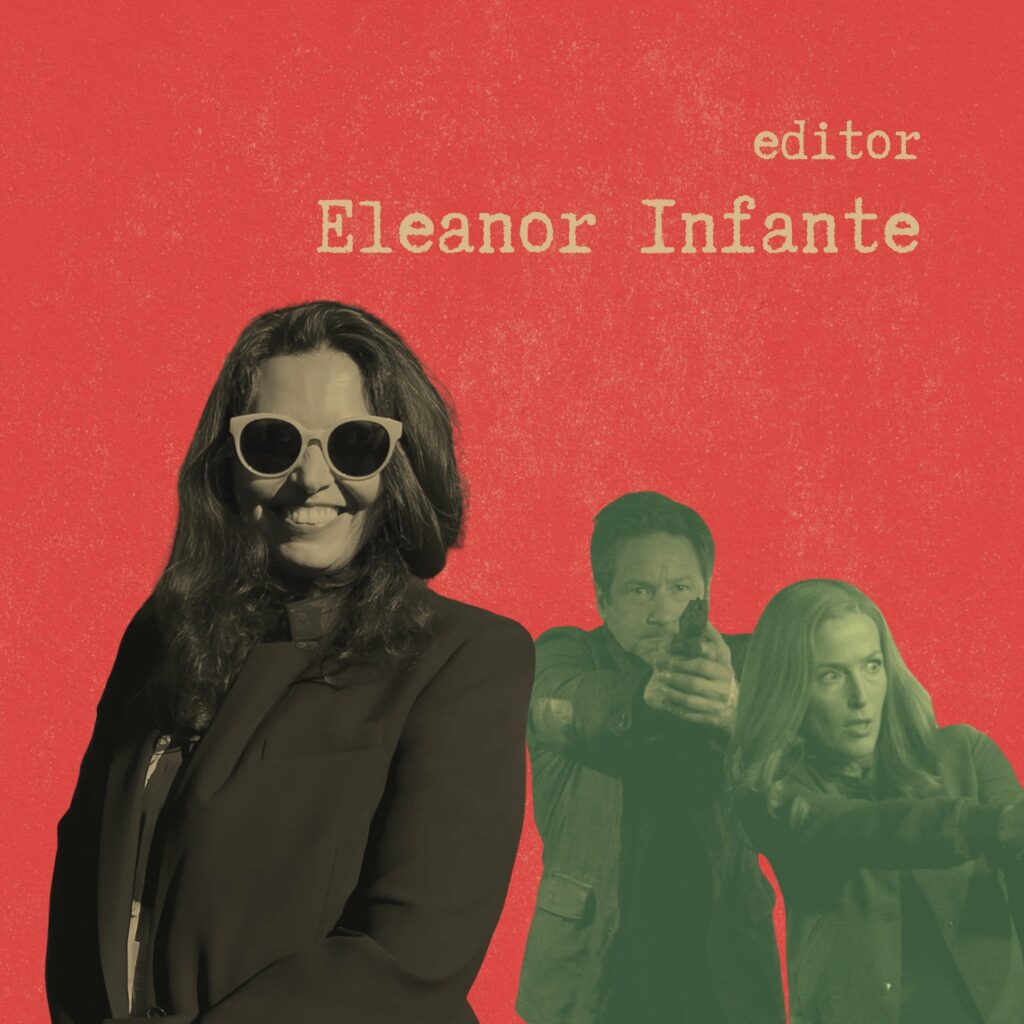
Still trying to catch up with recent interviews — here is one with Eleanor Infante, editor of 4 episodes in The X-Files season 11, with the “Hey Danny, it’s Mulder” podcast. Some interesting insights here:
She talks about working within the strict boundaries of length for commercial cuts in network television, as opposed to much more flexibility in streaming. [I think that can be negative as much as positive, as it inserts tightness in script and editing.]
Glen Morgan brought her to TXF. They did “Lore” together before (and worked on “The Twilight Zone” since).
She had never watched the show. As she was editing her episodes, she was watching a top 30 of episodes as per a list by Vulture.
Interesting difference in working methods between the two brothers: Glen lets editor give him what she wants, he is a collaborator, he takes what others suggest; whereas Darin is very specific about what he wants, she was a help for his vision.
11X02: This: for the group approaching the Mulder & Scully house in the teaser, Glen was inspired by Peter Weir’s “Witness”, with the dread of the cops approaching the Amish. He also wanted to use the Ramones song.
11X04: The Lost Art of Forehead Sweat: Darin is a perfectionist genius. He is all about language, rhythm. He sat with her and went through all the takes. She was the one who suggested to him that they use the a capella version of the main theme!
11X07: Rm9…/Followers: she had fun inserting draft sounds in the editing, Glen liked almost everything, then the sound department replicated it. The voice of the AI would have been Stephen Hawking himself, they were talking with his estate, but he was ill [he died just months later, in March 2018].
11X10: My Struggle IV: Build trust with the director-producer to take initiative, and move things around even if it was not scripted. She did that in this episode. Carter asked her to do an audio commentary of the episode.
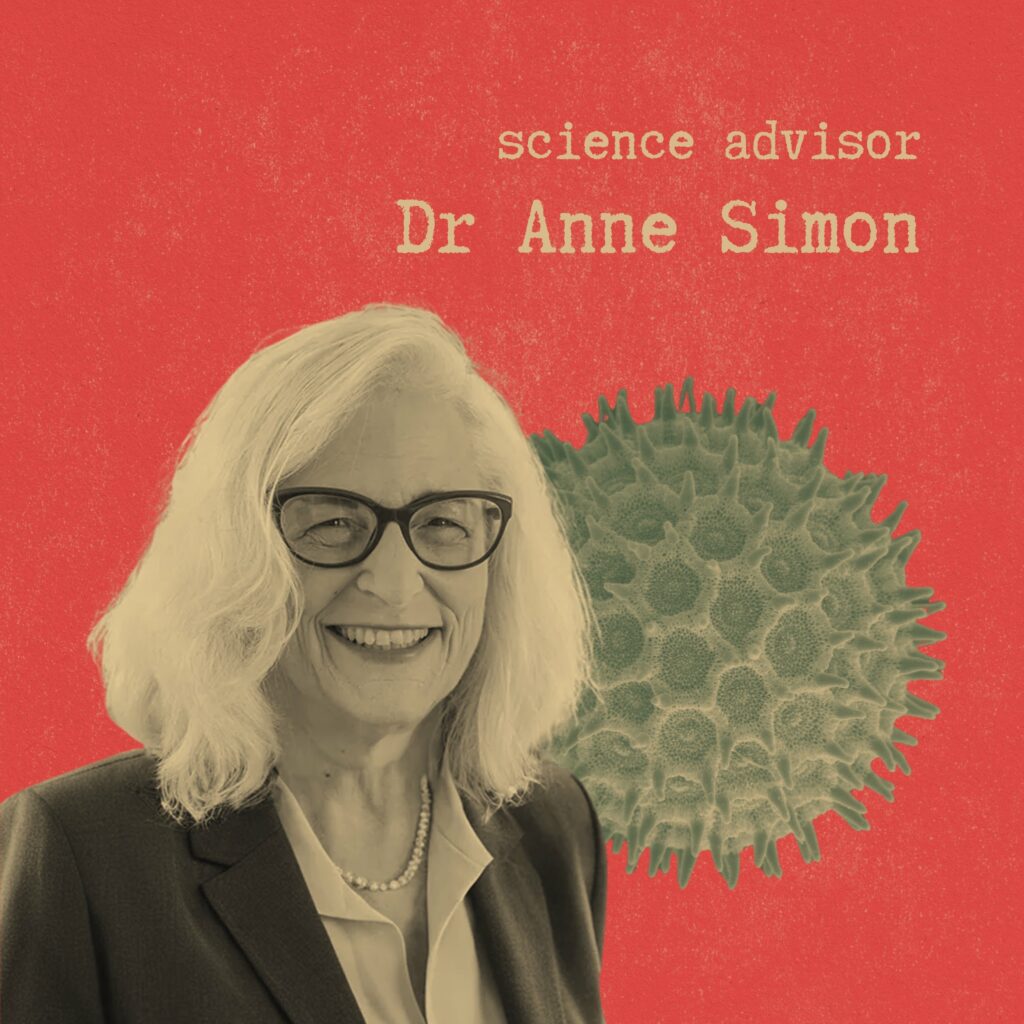
The “Hey Danny it’s Mulder” podcast interviewed Anne Simon, who was Chris Carter’s science advisor for much of the duration of the show and contributed with many realistic elements of the show’s mythology specifically.
What was discussed:
1X23: “The Erlenmeyer Flask“: plenty of contributions from her! The name of the episode itself, the solution contained in the flask that looks like “weak coffee” [“monkey pee” according to Scully], using an image of pollen for the alien bacteria, the two nucleotides as undeniable proof of alien DNA, the use of a scanning electron microscope, Carter naming the scientist “Anne Carpenter” after her…
4X01: “Herrenvolk“: using a real DNA sequence of cowpox virus just in case somebody would analyse it (which someone did of course!) to avoid having a random sequence like in Michael Crichton’s “Jurassic Park”.
5X02: “Redux“: the “blazing hot probe” story for the Southern blot test, which is normally done in two days but the script needed it to be done in four hours.
9X18: “Sunshine Days”: she and Margaret Fearon (TXF fan she met exchanging letters and became close friends with [a character in IWTB is named after her]) visited the set; they corrected several things in the set to make it more realistic (X-rays, position of the autopsied body, lab equipment…)
10X6: “My Struggle II“: all the details of CRISPR, Spartan virus (Margaret came up with the name), inserting the virus together with the smallpox vaccine, everything that got her and Margaret a writing credit for the episode. For the trigger for the loss of the immune system, she had many ideas around air pollution and climate change; but Carter wanted to use chemtrails specifically [it’s not very clear what the trigger was in the final episode].
[As noted in my My Struggle II analysis, this is all great science but it poses an issue of logic. It’s interesting that Carter asked them to come up with a way to have the virus and gene mutation inserted in all humans *specifically decades ago* and not recently: so the CSM’s Spartan virus plan was indeed set up a long time ago and that’s not a mistake or an overlooked detail. The CSM’s plan was in place decades ago, all the while the preparations for colonization and the hybridization experiments were taking place. This is all very difficult to reconcile: if the Spartan plan is in place and can destroy humanity, what’s the point of all the experiments related to colonization that we were presented for nine seasons?]
On scientists’ representation on-screen and scientists’ desire for a more realistic portrayal, on the Scully effect and the many times she became aware of it during her career.
But most importantly, Simon discusses the dire state of science funding in the new Trump administration, and how the United States is sabotaging itself by turning its back on science, and how a new generation of students is seeing its funding for research being taken away and its interest in science waning. [Progress based on science greatly helped make the American Empire during the 20th century. Now the situation is reversed and the US’s star, as a global beacon for people around the world and very practically as a leader of global affairs, is waning.]
More about Anne Simon on Eat The Corn:
Analysis of her 2001 book “The Real Science Behind The X-Files”, including things that might presage the Spartan virus [when will we get an updated edition?]