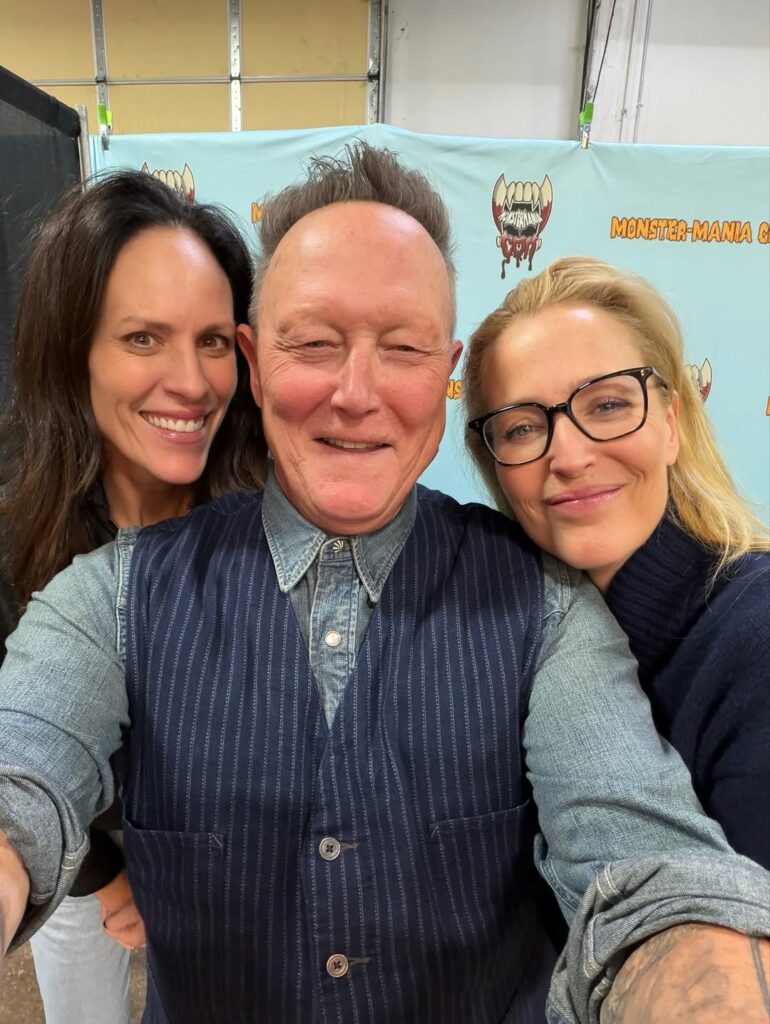
Some recent cast reunions in conventions were billed as The X-Files 32th anniversary events, and it’s true such events with so many cast members are by now rare.
This made for some beautiful photos. Robert Patrick says “pure joy“:
Fan Expo
With Gillian Anderson, Robert Patrick, Annabeth Gish, Mitch Pileggi, Nick Lea. Some highlights:
Robert: Doggett is his favorite role of his entire career!
Gillian typically doesn’t remember anything (but does remember the scene where Scully throws water on Doggett’s face), whereas Nick remembers details.
Robert remembers doing script table reads, nobody else does.
Mitch remembers shooting a scene with Duchovny, Carter called and was rewriting the scene, he passed the dialogue over the phone: that’s how a short notice they had with getting and learning the dialogue.
Nick: he had little notice, except the one time he knew he would have to speak Russian 2 weeks in advance [4X09: Tunguska].
Robert: the director of photography would give them directions to direct their flashlights to hit a board, so that the reflection would light their own faces.
Did they have any input to their character to Carter? Everyone, quickly: “no!”
Mitch didn’t like the prosthetics with the nanobots [6X10: S.R. 819], he told them to get rid of this storyline. [And so sadly this was another story thread that was not followed up, I would have liked it to.]
Annabeth watches Stranger Things and Pluribus, which tackle similar questions as TXF.
About 7X17: all things: Gillian wrote the outline one day until 3 am. Carter got Spotnitz to guide her through the process of turning it into a script. The 1st day directing she felt unbelievably lucky, the 2nd day she just wanted it to be over! She hadn’t thought of it beforehand but she wished she had spent more time working with the actors, working through each scene and what specifically she wanted out of them.
+ a panel just with Gillian, where she mentioned that getting back into the Scully character for the revival was really difficult.
Reboot talk
The Ryan Coogler reboot project was touched upon in Fan Expo.
Mitch has not been approached. Gillian had just one conversation with him it feels like 2 years ago, her knee-jerk reaction would be that she’s not interested as she’s done this already, but Coogler is talented and doesn’t say no, she’s interested to read what he’s created.
Gillian repeated just as much for a Screenrant interview: “I have no idea where they are at, or if it’s at.”
So any Scully reappearance talks in the potential reboot are way overblown, this is far from happening yet!
Monster Mania
Another cast reunion, same with the above minus Nick Lea but with William “Bill” Davis and Laurie Holden. Apart from the usual questions (do you believe, what’s your favorite, how did you meet Arlene, did you really eat the 2X20: Humbug cricket) there were two “incidents” I want to flag:
On the William arc, anything else you want to know? Gillian: I guess to find out who the father is. A fan shouts “The Cigarette-Smoking Man”…and Gillian gives Bill a comic look.
Anything you would like your character to do? Bill: I had to offer to write an episode to get some scenes with Gillian. Gillian: But he gave me something else instead. Bill: I didn’t plan that part.
This is both funny and tragic. It’s awkward to say the least that actors have to answer for the writer in front of fans… They will be doing this for the rest of their lives!
Gillian Anderson on “War of the Coprophages”
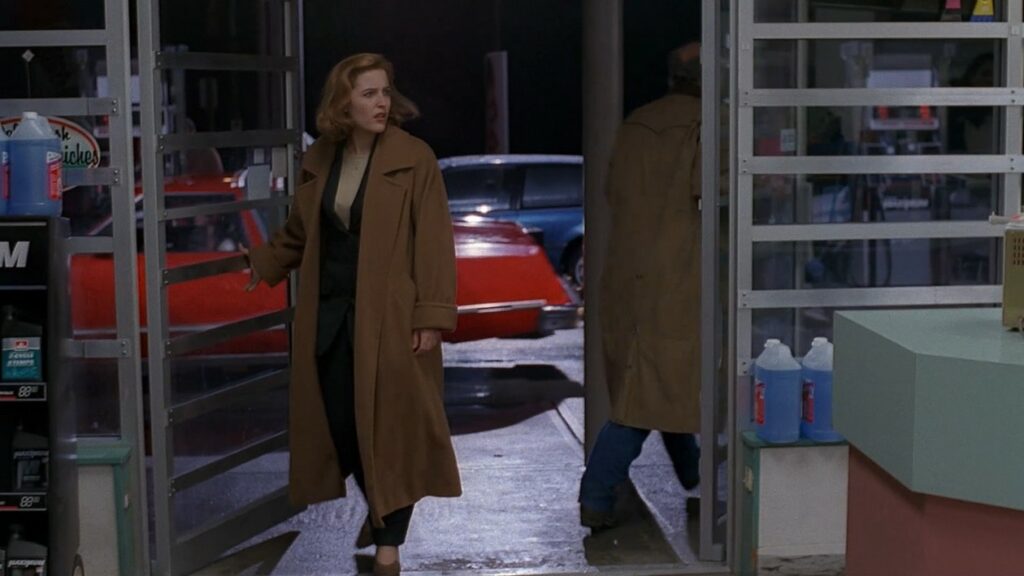
Gillian confirms on Jimmy Kimmel that the happenings in one shot in 3X12: War of the Coprophages were not planned: as she walks into a supermarket, a car accident happens behind her and an extra bumps into her. She continued in-character, and the shot made it to the final episode. Both these things were great and contributed to the sense of panic that the episode was trying to convey at that point!
David Duchovny on “Aubrey”
A story relayed by Annie on X-Files Diaries: David told her that one particular line in 2X12: Aubrey came from him, and not from script writer Sara Charno. The line in question:
Mulder: “I’ve often felt that dreams are answers to questions we haven’t yet figured out how to ask.”
This memorable line was repeated from Scully back to Mulder in 4X08: Paper Hearts.
Is this true? Let’s do some forensic work. We can compare script versions, thanks to boggsfiles: earlier script versions as late as the pink version (dated Nov 14 1994) don’t have it, while the yellow version (dated Nov 16, just two days later) has it. The dailies from that episode show that Nov 22 or 23 was day 5 of shooting, placing the start of shooting to Nov 18 or 19. So it looks like it checks out and that David could have provided that line after a script read just a couple of days before shooting began!
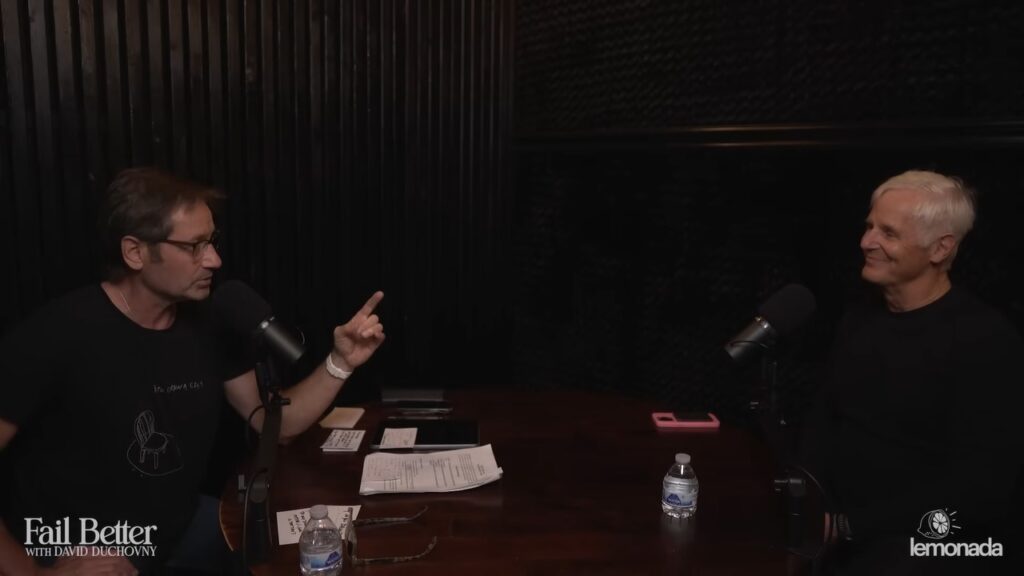
After the Gillian Anderson interview a few months ago, David Duchovny received Chris Carter on his podcast, to talk The X-Files and more. This time there’s a video version, and thanks to advancing AI and autogenerated subtitles it’s easier to pull quotes. I am also doing this to help people who prefer a text version instead of audio, or people who might want to automatically translate this page into their own language.
Overall a very enjoyable exchange with plenty of info. However, there are also some very weird parts. Once more, David tries to focus on how one becomes better after dealing with difficulties in life or in a career. Once more, Chris acts as if the world failure never applies to him and that the critics or the fans just don’t ‘get it’. There’s a lot of pop psychology that we could go into thanks to the many things said here, on why Chris has this attitude in life.
Here are the two highlights [with my comments]:
On the revival:
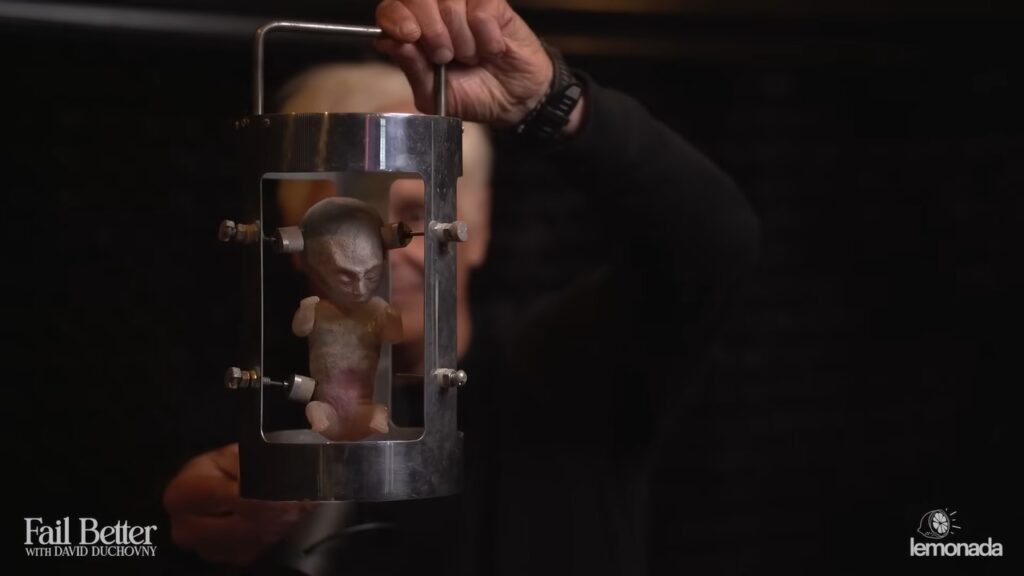
CC: “I thought, why why do I want to come back? What story do I have to tell? I don’t want to just come back and do a victory lap.” “I did a four part arc through two seasons to say all the things that I wanted to say. And the first story is a prelude to my point that I wanted to make.” CC goes on scorning New York Times critics calling ‘My Struggle I’ and ‘The After’ as “a dud” and “terrible”. CC: “[My Struggle I] was the episode that led us to the ending of the following season. And the big point which I was delivering, it was all a plan, was all veiled and complicated, and we get to the end and no one got the ending. I’ve already talked to you about this, that I laid it out there but no one got the ending. It’s a big, it’s a huge ending. Scully reveals that she’s pregnant, and I had a lot of haters, that Scully didn’t have agency, women are only good as mothers… I had a big idea and I put it right there, front and center, for people to make the connection that no one, literally no one, made. And you know what it is because I told you, you were the only one I told.” CC then stops talking and takes out the alien embryo prop from ‘The Erlenmeyer Flask‘!
[This is not the first time he hints at some bigger truth that ‘haters’ missed. But despite what he thinks, there’s been so much analysis by the fans that I don’t think absolutely nobody got it. Take your pick: Scully’s pregnant and this is again a miracle, possibly related to some new alien experiment, or man-made experiment, or triggered or enabled by William, who smiles at the end (and is shown hatching an egg in the teaser of the episode, having thus a life-giving force). Scully’s alien DNA generates alien-human hybrid babies (end of My Struggle IV echoing Sveta’s hybrid babies who were taken from her in My Struggle I) and the human race is slowly being manipulated into becoming a hybrid race, either by action of the CSM, or some secret human conspiracy, or by some covert action of aliens that have remained hidden for the entire revival. In terms of more general themes, the Struggles show we all have our biases and subjective truths (each Struggle episode has a point of view character) and we can get gaslighted by manipulators (CSM, William) but there is an objective truth we can reach to if we pierce through the lies. What more can the overall arc be possibly about? He should also reflect on why nobody ‘got it’, maybe these episodes are not his best work and not the masterpieces he thinks they are.]
On a new cut for IWTB:
CC: “I got just got the go-ahead yesterday to do a director’s cut of ‘I Want To Believe‘, the second movie, and I can’t tell you how excited I’m about this.” “I made it too scary basically and I was told so by the brass at Fox and they wanted a PG-13 movie, so we cut it back to be a PG-13 movie and we thought ‘OK we’ve satisfied their demands’. The critics, the people who rate the movies said, ‘no it’s not PG-13 yet, you’ve got to cut it back even further’. I can tell you that you can do more on network television, they’re more permissive than the sensors are for the movies. And so now I have a chance to go back and make the scary movie that I always intended. So it’s not just doing a director’s cut to do a director’s cut, it’s really kind of bringing to life something that for me was on the page and never got to the screen.”
[This is very surprising! Is Disney/Fox investing in this because of some new edition or 4K/UHD transfer of the movie? I’m certainly eager to see an edgier version of IWTB, but I don’t think the lack of scares or violence was its weak part. Making certain already-existing scenes longer will enhance it, but I don’t know that this will turn it into a better movie overall.]
Much more stuff follows:
All big 3 (DD/CC/GA) had lunch last week in Los Angeles. The podcast closes with the hope that they can do one all three together. [Nice that they still meet! could this be related to the recent series reboot project?]
Inside joke on set of TXF: “John Bartley, poet and a prophet / John Bartley, taught me how to off it”, to the tune of Red Hot Chili Peppers’ “Give It Away” [“Bob Marley” in the original lyrics; Bartley was the director of photography]
CC loves Terrence Malick and Quentin Tarantino movies. [Yay for the Malick reference!]
CC: “Story was very important”: “I did the pilot for The X-Files, I wrote a 17-page single-space outline.”
On the 3×5 cards for plotting out episodes in the writers’ room: “[Glen Morgan] actually had beautiful penmanship, and he would make these cards and so that became also competitive: who could make the most beautiful cards?” [everything became competitive in there, but in a good way!]
CC: “The great thing about The X-Files was that you were surrounded by people who wanted it to be good from the beginning. And that’s not, in my experience, always the case. Some people just show up for work. But certainly when we shot in Vancouver, it was that esprit de corps, it was the reason I got up every day to do the show, do the job.” [This team spirit comes up again and again in interviews by many crew members.]
CC: “By season 7, we were all tired.” During s7 when DD had a lawsuit against Fox, DD had his trailer checked for bugs, there was tension and distance with CC. Despite that, CC remembers seeing DD and his wife in Malibu, and hugging him. DD: “I was number one on the call sheet and you retired the number one which was really nice.”
On that “annus horribilis” when CC produced TXF S4 + Millennium S1 + preparing to shoot the first TXF movie: DD: “these are the fruits of success, that you’re going to work yourself to death.” DD on CC at that time: “I was pissed off because I thought Chris is not with us.”
CC on Millennium: “I didn’t want to do another thing, but Fox came to me and said, “You’ve got to, this is your brand, and run with it.” [Interesting that this was really a push from the studio and less of CC’s desire to expand to other things.] CC: “I pulled the plug on Millennium too soon.” “I thought [Harsh Realm] was going to be a hit and I didn’t imagine myself doing three shows.” [I can’t blame him! He pours his soul into his shows.] If not for CC’s decision, Fox would have gone ahead with Millennium season 4: “It was going to keep on going, they would have gone with it.” “I got excited about Harsh Realm because I got a chance to work with Dan Sackheim again, who had produced The X-Files pilot with me. There were a bunch of us that I was excited to work with. I thought it was a really good concept and that’s a story in itself. I thought it was and I still think it was a little bit ahead of its time.” [I can’t imagine HR going on for 100 episodes, but the 9 episodes that were produced were amazing and it was cut short way too soon. I don’t know what I would have preferred, a full season of HR or MM s4.]
CC on pottery and the creative process: “I went to film school when I was making pottery. I would have the TV on for 10 hours a day while I was making pottery.” “And then I would listen on Sunday nights… I just loved the Dr. Demento show.” “This is a story about my serialized brain.” “I could be called a production potter, which means I would sit for hours at a time and make the same thing over and over and over or the same six things over and over.” “It’s about the process. There’s something actually meditative and engaging about doing the same thing over, serialized. And what is television? It’s serialization of a concept.” [I love this parallel!]
CC remembers important experiences that made him into a writer: writing blue book essays for a writing teacher (Mr. Lackman) on Herman Melville’s “Billy Budd“; in journalism school with a teacher (Dr. Stein), writing a piece on Gaylord Carter (silent movies organist). “I’m a hard worker and I hate to hear the word ‘no’. And I wanted to be good at what I was doing.” [He has this work ethic still.]
On how CC got into Hollywood: He was next door neighbours with James Mangold [director, ‘Indiana Jones and the Dial of Destiny’ among others]. He met his wife-to-be Dori, whose cousin was Dianne Crittenden, an agent and the casting director on ‘Star Wars’. They got him to write scripts and shop them around. [Sounds like it was quite easy for him!] CC: “The first script I wrote was… I’m from Belfflower. I wrote a script about three kids in Bellflower in the early 1970s who are baseball players, who have no idea that they can get out of the Vietnam draft, and they’re going to war because they don’t know how to not go, they don’t know about bone spurs. [Donald Trump avoided the draft claiming he suffered this ailment.] “The script is called ‘National Pastime’. It’s near and dear to me. It’ll never get made.” [Sounds like his own ‘American Graffiti’.]
In season 1, CC wanted DD & GA to go to couples therapy. CC: “You guys were at odds” “sometimes on set, that kind of thing rocks a crew” “if there is tension and you guys are the center of attention, if there is tension in that relationship, everyone knows it and it affects…”
Shooting “Squeeze” (season 1): DD had already done his ADR (re-recording voice in post-production) and was unavailable, so CC recorded his own voice for Mulder instead, for that shot when Mulder finds Scully’s cross: “damn it”. CC: “I don’t remember how you figured it out, but I remember your reaction, which was not good.” DD: “I was really pissed off and I remember you being bemused.”
The “widows and orphans” in CC’s scripts: DD: “in your chunks of dialogue, you wanted it to look symmetrical, and so you would make sure that each of your lines added up”. DD: “I’m reading your dialogue for 20 years on and off. And there’s always ellipses, ‘—‘. And in my mind, when I read a script like that, especially when it trails off at whatever in the middle, I’m thinking there’s a thought that’s not being expressed, and I’m thinking, well, what is what is the thought? And I’m always trying to fill it in.” DD: “So it it goes with my kind of philosophy that that self-imposed limitations which you’re giving yourself that it has to look a certain way are actually ways to get at deeper meaning and and freedom.” CC: “People don’t speak in complete sentences.” CC: “For me it was an exercise because I always think, if you can say it in four lines instead of four and a half it’s going to be better.” [I understand the will to have more natural dialogue. But compare a typical page of his early scripts with one of his revival episodes and maybe he’s overdoing it.]
Casting TXF: DD: “I had to convince the suits that I was the guy. And there was a line in the pilot in the description where you you described Mulder as like more MTV DJ than like FBI. So I was like, ‘Oh, he’s a bit irreverent, whatever’. So I came to the test wearing a pig tie.” CC: “We left the casting session. I actually talked to you outside and I said, ‘You’re good. I want to take you to the network’ and I said the stupidest thing, ‘I want you to start thinking like an FBI agent’.”
DD’s revelation about Mulder’s psychology: DD: “I gave thanks to you for kind of giving me a structural education in storytelling, I was coming to storytelling in a completely psychological sense.” DD: “Mulder is traumatized by his sister’s disappearance. Trauma is a word we use now, but we might not have said that back then, we could say something like PTSD now. He failed to protect her. That’s his trauma. He failed. But now he’s returning to the scene week after week and putting another young woman in jeopardy and sometimes failing, almost failing, to protect her. As if he’s trying to heal himself by protecting Scully in the way he couldn’t protect his sister. Yet he’s also reinjuring himself by putting her in danger and sometimes even having to be saved by Scully, saved by this sister proxy.” CC: “I never thought of it that way either.” “I guess you you could make a case for that. I don’t know.” [This is very insightful and I love this angle, it really makes the Mulder character work for me, to the point that it’s surprising Carter never thought of this. It’s also the type of analysis that I think fans were producing already back in season 1.]
On when DD was feeling low after receiving bad reviews for ‘House of D’, DD was mumbling/crying, CC told him “I want to hear your big boy voice”. CC: “That’s a Bill Carter instruction. He wouldn’t have said that exactly, but it was like, ‘buck up’.” [Sounds like Carter received some tough education from his father.]
CC: “Doing the X-Files was a perfect opportunity for me to talk about the world and my point of view in the world, or I should say my competing points of view, which are science and faith.”
CC: “I once told David long long ago, 30 years ago, that my first novel was going to be called Men in Their Hair.”
DD: “the reason that The X-Files was so scary in the beginning was because we couldn’t afford to show the scary things. It had to be dark” [He makes fond fun of director of photography John Bartley’s accent, who was from New Zealand] “If you have a small budget, you have to figure your way around the scare. And that explained or that drove The X-Files when it first aired, it was so dark compared to any other show on television — and I’m talking about literally — and that became its trademark, and that became the art of it.”
Last week the star-struck fandom discussed to death Gillian Anderson appearing in David Duchovny’s podcast. Although we hardly learned anything new on #TheXFiles themselves, it was a perhaps unprecedented insight into the actors’ personalities, a bit like listening in on an old couple’s therapy session.
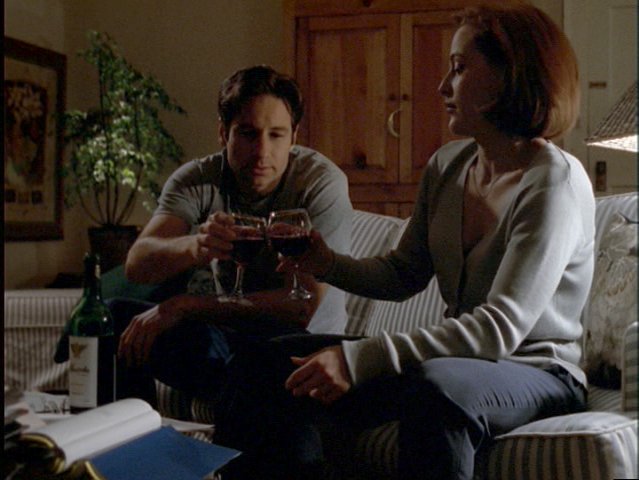
As I was listening to their conversation, the following exchange came to me, from “Small Potatoes”:
Mulder: “We never really, uh, *talk* much, do we?”
Scully: “What do you mean like, really talk? No. No, we don’t.”
This could really be the actors talking. For all their on-screen chemistry and their off-screen banter in public appearances, they don’t seem to really know each other much, or be much on the same wavelength. They have the sort of familiarity you have with a childhood friend but with whom you have grown apart over the years and you now only see once every few years, and your being comfortable with each other just comes from the fact of having spent so much time in the presence of the other in the past.
Their conversation plays exactly how they describe themselves to be: DD deals with his issues by talking about them and holds remorse about things in the past, while GA deals with her issues by not talking about them and filling her life with new work and experiences, living in the moment. As such, DD mentions, very candidly, several experiences of shame and regret in his life, including how he acted like a presumptuous movie star on the set of the show — while GA doesn’t remember much in terms of specifics or is more reserved and would rather talk about issues that are close to her heart today.
That’s what I got from it. I enjoyed it, but I’m not much of a person who follows actors closely.
I got zero hint of them trying to spur up excitement for a continuation of the series, and that’s fine by me.
Other than that, some TXF-related stuff:
As is well established, DD & GA were not particularly getting well along on set, and sometimes spent weeks without talking to each other.
This got to the point where Carter advised them to go to couple therapy but as their characters (in season 1!).
Being in their 20s-30s and have the show become such a success while at the same time dealing with their personal lives (pregnancy, divorce) was huge, huge stress.
DD wanted Mulder to be more action-hero-like, as Mulder was not traditionally masculine (losing his gun or fist fights).
DD remembers strong shame in being rejected by Vancouverites when he forced the move to Los Angeles.
As DD left the show in season 7, GA left the show in season 11 — and DD now felt that he should have apologized for leaving originally, because her leaving now hurt him.
GA approached the revival as a one-time special event, not a return for an on-going series.
GA specifically mentions the ending of season 11 as problematic for her, “particularly for Scully”: “it felt like Scully’s trajectory was no longer one of strength and agency it felt like it was beholden to an old idea of of what a woman is, and that’s [William/pregnancy] all she could talk about”; DD didn’t react to that ending in the same way.
More than any other event earlier this year, and I expect more than any even for the remainder of 2013, The X-Files‘ 20th anniversary was celebrated at San Diego Comic Con International 2013. The size of the event and the media coverage it got is the reason why this was a key event. The big panel was hosted by TV Guide, the second panel by Season 10 comics publisher IDW, and then there were of course signings and pricey photo shoots.
X-Files’ 20th anniversary
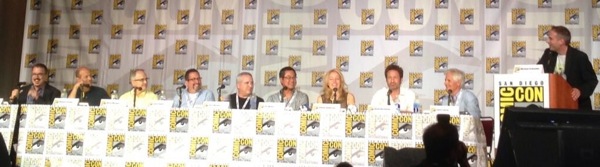
This was the biggest cast & crew reunion since the Paley Festival in 2008. From right to left: host Michael Schneider; Chris Carter; David Duchovny; Gillian Anderson; James Wong; Glen Morgan; John Shiban; Darin Morgan; Howard Gordon; Vince Gilligan; and out of frame, David Amann (photo from syzzlyn). From the writing team, you could say that all the people who shaped the show were there, apart from Frank Spotnitz (in Europe, busy with other projects) and Gordon’s writing partner Alex Gansa. As would be expected in such media-intensive events, the focus was much more on Anderson and Duchovny instead of the rest of the creative team — given how short the panel was, some of them only spoke once!
Host Michael Schneider posted a kind of “making of” of the whole event, which is a very entertaining read but is also revealing. The panel was organized by TV Guide, and within TV Guide, Schneider played an essential role: in inviting people and handling the organization of the event on the day. The involvement of FOX is nowhere to be seen apart from their mere approval. Still, we guess that they were watching, gauging interest in the X-Files to see if it has a future. The fans were certainly there!