The X-Files mythology, Ten Thirteen Interviews Database, and more

Posts Tagged ‘xfdiaries’

Interview: Darin Morgan

In my effort to cover in-depth all the Ten Thirteen interviews, there are times I get lost in my obsession with notes-taking. Here is a long (3 hours!) interview with the unparalleled Darin Morgan from… January 2025 — an interview for the X-Files Diaries podcast (now rebaptized Seriously Obsessed). What a joy to have such long interviews! In the past, interviews were most often written pieces by professional journalists for published magazines; in the past few years, there has been an explosion of interviews with the democratization of podcasting. Today, I get the impression that we are at the tail end of that wave as well.

Darin goes in-depth on all of his X-Files episodes and offers many details I don’t remember hearing elsewhere. Enjoy! Here are my notes [and occasional comments].
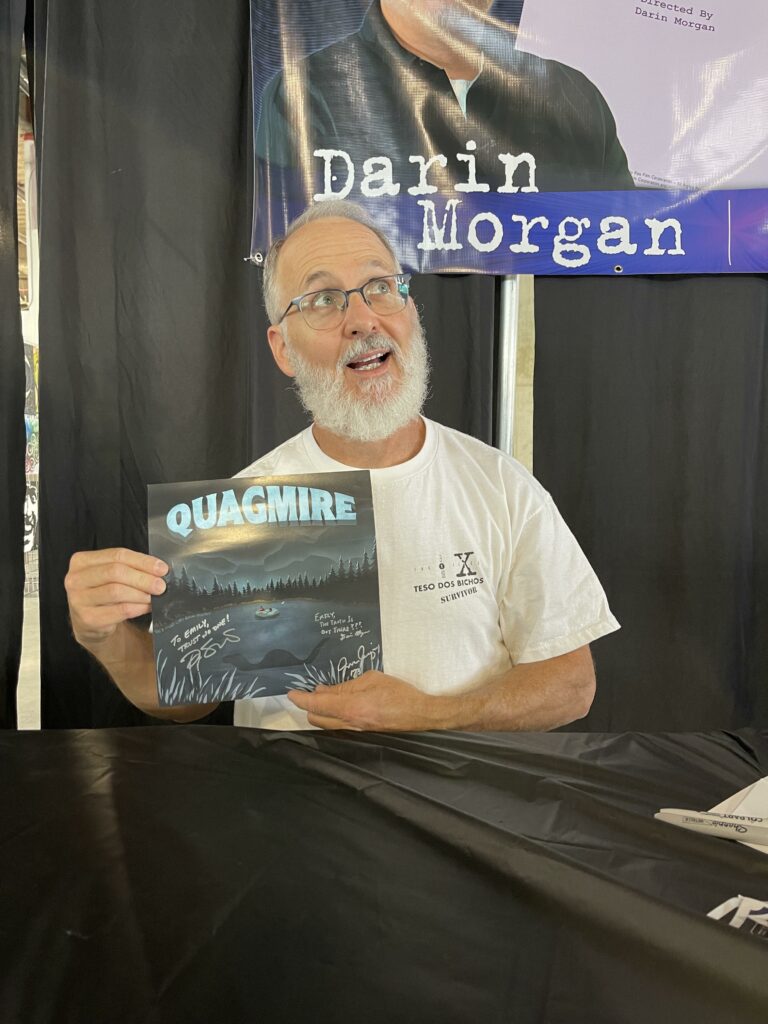
Image taken from reddit

Part 1

Jose Chung’s ‘From Outer Space’: from the very moment he was hired in season 2 he had the idea of the teaser, an alien abduction abduction; he didn’t have the rest of the episode, he couldn’t figure it out. As a result, he did “the killer cockroaches episode” first. While casting that, one actor was just like Truman Capote (they didn’t cast him). He thought that instead of In Cold Blood he would write a story about alien abductions, and he figured the story out! Earlier in Coprophages he has Scully reading a Capote book, which was an inside joke to Duchovny’s appearance on Jeopardy, as if the idea was there and trying to tell him to pay attention, he was not receptive to it yet.

Blood: Glen gave him the story, machines tell people to kill people, and told him to write it. Glen would try to convince Carter to hire him, then they needed urgently a script in a day. He came in to break the story with Glen, Jim and Howard Gordon, then Glen and Jim would write the script real quick. Darin remembers contributing with nothing. Gordon thought Darin “got” the show. Then a writer was fired, there was an opening. The Flukeman role was because Carter knew Darin was looking for a job. He thinks he got the writing job thanks to Gordon. Carter says he perceived something in Darin, but he hadn’t read anything of his. Carter had a sixth sense to recruit people he could trust, a talent.

He discussed with Glen how long the show would last, they estimated 3 seasons. Jim told him to save the idea for season 4.

Humbug: Glen told him to do an episode about circus freaks, he loved the movie Freaks. He gave him a VHS of Jim Rose. He can’t write without comedy, he’s not purposefully trying to deconstruct. Carter should have fired him when he pitched the idea, but he liked the story. Glen had him change a few things, but mainly he wanted Chris to know what he got into. Carter liked the script even if it was “not the show”. Fox had a huge problem, they were worried. The talent of Chris was that he thought the fans would accept the difference.

He recognizes that he wrote few episodes and had an influence on the show. Although he thinks that somebody would have done comedy down the line, and he’s not a fan of many of the comedic episodes that followed. If the first one had been bad, like Fight Club [ha!], then they wouldn’t have done more. Everybody was nervous. Manners thought it would end his career. He is somewhat resentful of the comedy episodes that followed his because they didn’t have to go through what he did, they were not new, there was no pressure. Humbug was enjoyable, it was raw energy. The end product is always less than what the idea was, some lines were not great [typical self-depreciating Darin]. He would have written it differently now, better.

The audience is so-called more sophisticated now. But Humbug was received more easily than Were-Monster. He had no computer during the original run. In the revival he read everything, that was unhealthy.

Coprophages: he had a very hard time writing it. His own opinion of the episodes is tied to the personal experience of working on them. The inspiration for Bambi was an entomologist in the University of Illinois, she did a festival around insects in horror movies, and a few years ago she invited Chris to show Fight the Future and Coprophages, and Chris invited Darin, so he saw it with an audience. About the stoners: he read someone was trying to get high on crap. TXF needed unreliable eye witnesses.

Quagmire: he is credited as doing a rewrite but it isn’t true, he wrote the Conversation on the Rock [That’s already a lot!] and he helped break the story. The stoners were not his idea, it was Vince who wrote that scene. It was a group effort. He doesn’t like Easter eggs, he likes references to past episodes, it’s amusing, like how the past carries weight, like how a continuous story series would do now.

Back in the day nobody wanted to have Mulder and Scully romantically involved, as it would become a different show; they had to be thinking about weird stuff, monsters. The M&S couple was interesting because they had been through so much and nobody else could relate to them. The jealousy in Coprophages was for comedic effect, it had not been tried before. Gillian had to do some other work, she would not be much available, hence she had less scenes, Bambi was introduced, it was a scientist taking Scully’s job away from her, it was also a professional jealousy. The performances played the MSR well.

MSR in the revival: people who have been through so much, on and off, understand each other like no other, they don’t need to define what they have. He wonders what it would have been like if M&S each had had life partners. The long term trajectory of the MSR was accidental.

Coprophages doesn’t have a good main character that the episode would be centered around. Bambi and the roboticist are one-note.

The only actor he wrote the part for and was cast was Jesse Ventura. He didn’t have actor in mind for Clyde Bruckman; he considered Bob Newhart jokingly for 5 minutes. He drove Rick Millikan crazy, he was a movie guy, he didn’t know TV actors. He was very lucky with the casting. Casting is very fun but also torture. He wanted to cast Rip Taylor for Jose Chung, he seemed more hip, but he was unavailable. Charles Nelson Reilly gave the best audition. His first scene was the interview with Scully, Darin was there on set, he seemed perfect for the role. He knew Reilly from “Lidsville” (1971-1972) and “Match Game” (1990-1991). He didn’t meet Peter Boyle [Clyde Bruckman] until after the episode was shot. The guest stars had problems adjusting to his episodes, they thought TXF was a drama. Watching Stuart Margolin’s audition tape [Dr They], Glen said older actors understand what they’re looking for, they have experience in theatrical performance, younger actors don’t. He knew Stuart from “The Rockford Files” but he didn’t watch it as a kid. These actors always worked, either in theatre, or directing. He gave him directions and he understood immediately, he was in complete control of the craft.

He didn’t write Scully to be immortal, that’s bad sci-fi. But after he left, the writers were free to do whatever they wanted, it was out of his hands. Maybe that’s what Chris’s plan. Same with Mulder-Scully relationship, if they’d ever kiss he wouldn’t be the one writing it.

Clyde Bruckman: he was trying to do an episode like Beyond the Sea, he thought it was the best episode of the early seasons, very inspired. Vince was an admirer of Clyde Bruckman, perhaps it inspired him for Tithonus? Chris let writers have their own voice, their own approach, but not everybody had a good experience writing for the show. The best work of the different writers is recognizable and connected across the series. A series is its best episodes and for TXF they are very different from each other. He is proud that Chris didn’t have to spend time breaking, writing and re-writing his season 3 episodes. Glen & Jim could do 8-10 episodes per season on their own, Chris needed writers like this.

Mulder was on a mythic quest and acted like it, he wanted to make fun of him. He felt sorry for Scully, to be involved with someone she cares about but is crazy. In the revival his attitude to Mulder changed dramatically, he was more sympathetic to him, David appreciated that. Once he finds the truth, then what happens, what does my life amount to? And he is still sorry for Scully. M&S are obviously in love with each other, but they don’t get along all the time necessarily. Mulder is absorbed in his quest, he couldn’t see he had this beautiful woman next to him, in the revival he is more receptive.

The preying mantis scream in Coprophages was from his own experience, he saw a “walking stick” in a tree as a kid. He still laughs at Mulder’s yell in Jose Chung.

Jesse Ventura’s car scene in Jose Chung: the old car moved slow, so it was accelerated to make it look faster. Then they started pulling apart the set, and Rob Bowman was not sure if it would look too comical; Darin’s answer was “maybe!”, then Rob rushed to shoot one more take with a different speed. That’s the chaos on set. The car exit in reverse is an example of Darin’s theatrical writing, like a scene exit.

While he was walking his dogs he ran into Rob Bowman! He hadn’t seen him in decades, they had lunch. He told him about fans loving Jose Chung, this was odd for him, he doesn’t consider it his best work. [Wow!]

Part 2

Jose Chung: He was a fan of Jesse “The Body” Ventura, he was a wrestler fan as a kid. He’s hilarious as a commentator and in action films. He wrote lines for him, but he had trouble with them. It was the best performance in any of his film work!

For the Men In Black (Alex Trebek) he had originally in mind Salman Rushdie [!]. Carter and Bowman shot down that idea. Glen suggested Johnny Cash, but he was unavailable. Darin thought of Steven Spielberg [!!!]. He wrote a letter to Spielberg, but they got word he was unavailable before the letter was sent. A couple of years later Darin had a meeting with him, and he said he would have done it! [Imagine that! Also, Darin and Spielberg met?! In what context?]

He was throwing names around with Jeff Vlaming and came up with Alex Trebek, with the Duchovny Jeopardy connection.

Small Potatoes: He did a single shot after morphing back into Eddie from Mulder, Gillian was probably not there when it was shot, the SFX shots were done last; he was not wearing pants during that shot. If you don’t see David or Gillian from the front, then probably it’s not them, it’s their stand-ins. He hadn’t acted in a while, he could have been better. Vince saw a weird quality in him, that he had an ability that he didn’t know what to do with, so he cast him.

Queequeg: he didn’t have a dog at the time, he gave Scully a dog without thinking of the implications or running it by Carter. The fans started asking about it, and Carter said to get rid of it. Gillian didn’t like the dog, Darin didn’t choose it. He broke the Quagmire story in a day. He needed a victim for the end; he pitched it to the staff; someone suggested the dog. He wouldn’t do that now, neither would Carter. 

When they started the revival he didn’t know that they had had a kid.

In the revival, Scully needed a dog, to make up for it. She got a better looking one. He didn’t have the intention to bring Dagoo back. In his mind, Scully has a pack of dogs.

Directing in revival: he had forgotten how long things took, it was frustrating for that. There are things wrong with Were-monster but he doesn’t know what he would change in it. He had fun with Forehead Sweat. When the director is another person you have to explain things, sometimes they bring good things. He learned a lot from the 3 great TXF directors. He was glad Carter let them direct in the revival.

Guy Mann has a line about internal logic, it was a meta comment about TXF, none of it makes sense. He was watching old Universal monster movies like The Wolf Man, the detailed logic didn’t make sense. TXF is that type of story. It was also a comment on our lives that make no sense. He lived in fear somebody would do the were-monster story before he could do it.

Forehead Sweat: what would Rod Serling write about Trump?

The best Twilight Zone episodes are a guy trying to explain what’s happening, and their heads have forehead sweat. “Lost art” because he doesn’t see that any more. Then he would rewatch it and he would only find just a handful of episodes like that, a Mandela effect.

His dad’s favorite episode that he wrote is Small Potatoes. [Ironic!]

He read comments that fans said this episode is going to age so quickly because of Trump references, but the episode is more relevant now than when it aired. He watches news about gaslighting, disinformation, waiting to hear “it’s like that episode of TXF”, it’s only gotten worse.

It predated QAnon; the middle name of Dr They was “Q”; he wanted to start a rumor that QAnon was a publicity stunt by TXF.

Being specific vs being vague. In the end, was Reggie crazy? The episode aired one year after Trump’s inauguration. One year ago, Reggie had a nervous breakdown. The last flashback was when Trump was coming. It was the demise of American idealism, Trump becoming president was the last straw. He had a line for Reggie, “Trump became president and my head exploded”, it was too on the nose and he cut it. The alien-as-Trump is part of his breakdown. Reggie was when the president no longer represents your country’s ideals. But nobody saw that. TXF had to have a vagueness to the ending, like, “here’s the explanation, but, who knows?”.

For the fake credits scene, the script was due the next day and it was the last thing he wrote. He watched the series in fast-forward, he only had the DVDs for 2 seasons, he bought a subscription to Hulu just to search a scene to insert Reggie during that one night. In the Small Potatoes butt crack shot, the SFX guy told him there was only enough room to insert Reggie if they just removed Mulder. He always laughs when Reggie shoots him [Darin].

The intention was for the alien to give a Trump-like speech. But then it would be perceived as anti-Trump. So it the speech had to be verbatim, to use the exact words.

He has tons of references to the 1970s, film quotes. It was the beginnings of conspiracy paranoia. One of the references was the Elvis cape, his Las Vegas era, which people found weird; then recently people started referring to Trump as being in his “fat Elvis” stage, now it works.

He doesn’t remember that Mulder is color blind.

The episode’s ending “can’t be” a series ending, but it is his ending, his finale for the series. [It’s a great series finale all right!]

He didn’t call the episodes “monster of the week”, he called them “stand-alones”.

As per Frank O’Connor, two characters in fiction are actually one person. This is Mulder and Scully. They are “platonic soul mates”.
Interview: Chris Carter on “Triangle”

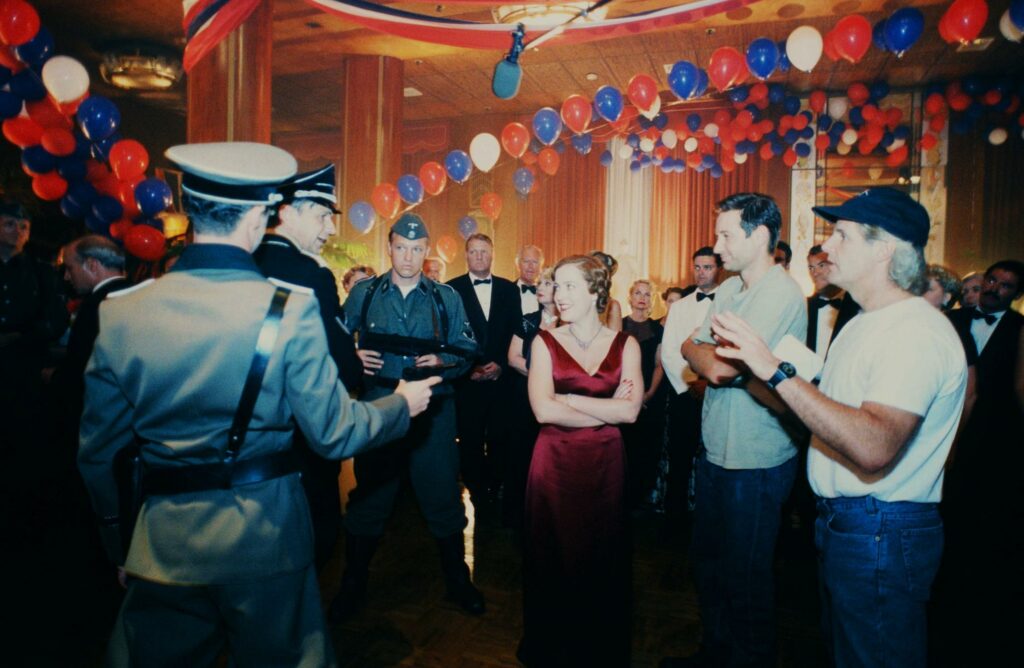
Recently, the “X-Files Diaries” podcast interviewed Chris Carter on his season 6 directorial riff on Hitchock’s “Rope”, the excellent fan-favorite “Triangle”! Carter was glad to get into the details here, on story choices, on technical details of making the episode itself, and reflecting back on the series that we cherish so many years later. Some insights on the larger structure of the series too — MSR and the mythology! Here is my summary/notes:

  • He got the technical details of one camera reel holding 12 minutes while shooting in Vancouver. 
  • He was interested in World War 2, and wanted to see TXF characters as a Nazi, a double agent, M&S saving the world. 
  • He slept aboard the Queen Mary while shooting. 
  • Bill Roe was the new director of photography. The problem was how to set up the lights when the shot shows everything. 
  • He imagined it as set during night, but night also helped with hiding some cuts.
  • Unheralded crew members for this episode in particular: steadicam operator Dave Luckenbach and focus puller Trevor… [No Trevor or focus puller is credited for the episode, unfortunately!]
  • They just shot the episode and there was no space to edit, miraculously it added up to the exact 45 minutes needed! 
  • David Nutter taught him how to block scenes, “the master”. 
  • Production designer Korey Caplan gave him a paper with the set drawings, he did the choreography of the scene on paper.
  • Moving to LA, Michael Watkins and Bernie Caulfield replaced Bob Goodwin to run the day-to-day business. 
  • Praise for Kaplan. The trashed ballroom was made and unmade in hours. 
  • The “Wizard of Oz” references were added in in order to fit in all the cameos. 
  • The original script had Fowley as the ballroom singer. He doesn’t remember if it was actor availability or budget that cut her. 
  • Mulder’s line for “what’s your name?” “John Brown. Ask me again, and I’ll knock you down. / Puddintame. Ask me again and I’ll tell you the same.” was from a 70s TV show, he doesn’t remember which! It was an inside joke with childhood friends. [Apparently it’s a quite old children’s rhyme from the US. There was even a 1960s Alley Cats song that used it!]
  • The move to LA was a lot of work. During the Vancouver days he used Air Canada like a Greyhound bus. 
  • He always wanted to shoot in the Queen Mary. 
  • About the fan theory that the whole of season 6 was a dream: “I don’t know that we were so organized.” Things were made up on the fly. [I find that quite telling, on how well-planned everything was — or not! — and this can apply to the mythology as well.]
  • If he wanted to have writing done, he’d have to do it before the phone rang. He’d get up early, get a Starbucks in Venice exit to Santa Monica at 4 am, becoming friends with the homeless, at 5 am he’d be at the office, and write till 9 am, then deal with the other parts of the job. 
  • The FBI elevator shot, the set was redressed while the doors were closed. There was not enough time for many takes, thankfully DD & GA didn’t flub (make mistakes).
  • The velocity of the episode allowed to include hidden cuts. 
  • Mark Snow’s music: a riff on big band, 1940s music. The “Sing, Sing, Sing” song was in the script. 
  • The M&S kiss: did we get because it was not for real? “Definitely!” It was a 1940s movie kiss.
  • He rewatched the show from beginning to roughly end 2 years ago with his wife. The specifics of making it are all a blur. 
  • About the shipper teases: “Hats off to the writers” for telling TXF stories and weaving in those threads. [He’s one of the writers, but the congratulations are for the whole team of writers.]
  • They would often work on the mythology episodes together with Frank Spotnitz; they talked so much that the stories started to tell themselves. “The architecture of the mythology would oftentimes tell us rather than us tell it.” [How I would love to have a recording of one of those brainstorming sessions!]
  • “I love you” at the end: the entire episode is silly, it calls on them to act out of character. “We all know they both love each other”, it’s just not vocalized. It satisfied expectations, and takes some “devilish liberties” with the characters. 
  • Did it really happen? “It’s the ‘Wizard of Oz’!” [Take note, fans, not everything really needs to be unambiguous!]

Interview: Kristen Cloke-Morgan

Another interview courtesy of the X-Files Diaries podcast, this time with Kristen Cloke-Morgan (Glen Morgan’s wife and creative partner), talking in-depth about the revival episode that she co-wrote, the memorable no-dialogue AI episode. Quick notes below:

On “The Field Where I Died“: she thinks the background of her character was that she was probably abused as a child, every time she got in a difficult spot she escaped into another personality.

On “Rm9…“, which she calls “Followers“:

  • Glen Morgan had 3 ideas: drones, no dialogue, AI (maybe?)
  • She and co-writer Shannon Hamblin boarded the episode at the Morgans’ garage, then photographed the cards and took them to Vancouver for Glen to give notes. It was a collaborative writing process.
  • They had done an episode of “Space: Above and Beyond” with no dialogue.
  • The actors liked it.
  • Scully wearing more comfortable clothes and shoes was not her input.
  • The funny bits are Shannon’s, she’s more serious.
  • There are few women in TXF. It would have been awkward if a man had written Scully with a vibrator. The vibrator design had to be approved by the studio! The vibrator idea came out of research they did on connected devices.
  • They were able to have notes and rewrites on the spot in Vancouver, they were there during prep. They produced their own episode, like Carter had writers do back then, now writers don’t do that any more.
  • Many of the crew in Vancouver they knew, collaboration was great.
  • Scott Stence (?) did the videos and graphics, he came up with the design for the smiley face, she had him add teeth to make it more creepy. “Scott is coming for dinner” on Scully’s fridge was an easter egg, it was not scripted.
  • Hand holding at the end was Glen’s idea, about connection.
  • Mulder’s line “why is your house better than mine?” was improvisation by Duchovny, they kept it in.
  • Shooting in Mulder’s house was very cold.
  • They removed the last line of Scully replying “we can’t teach them to care”, they rewrote that line a lot, maybe it was Glen that cut it out.
  • It’s inevitable that, where it can, AI will replace humans. But it can’t write something that will move you like TXF episodes written by humans.
  • In the Tay experiment [Microsoft AI chatbot on Twitter], the female-looking AI was abused by males and taught racist sexist things. She was moved by that.
  • Robots and AI are much more frequent now vs 2017. Glen used AI images to help for movie pitches. She feels like she is participating in teaching it, and is reluctant.
  • She had ELO songs in the script originally; she is a Prince fan.
  • When Mulder and Scully got out of the restaurant, a hug was scripted but a kiss was shot, it was cut out.
  • Anderson didn’t remember the song “Teach your children well”, Shannon led a rendition for her.
  • She was amazed at the set of the sushi restaurant, by set designer Mark Freeborn. She was impressed by the robot wranglers, the programmers for the robots’ movements, the drones people. There were few robots on set, they were duplicated digitally.
  • An important distinction vs TXF in the 90s: with politics now, you believe in the truth you want to believe, you create your own reality, instead of believing in The Truth.

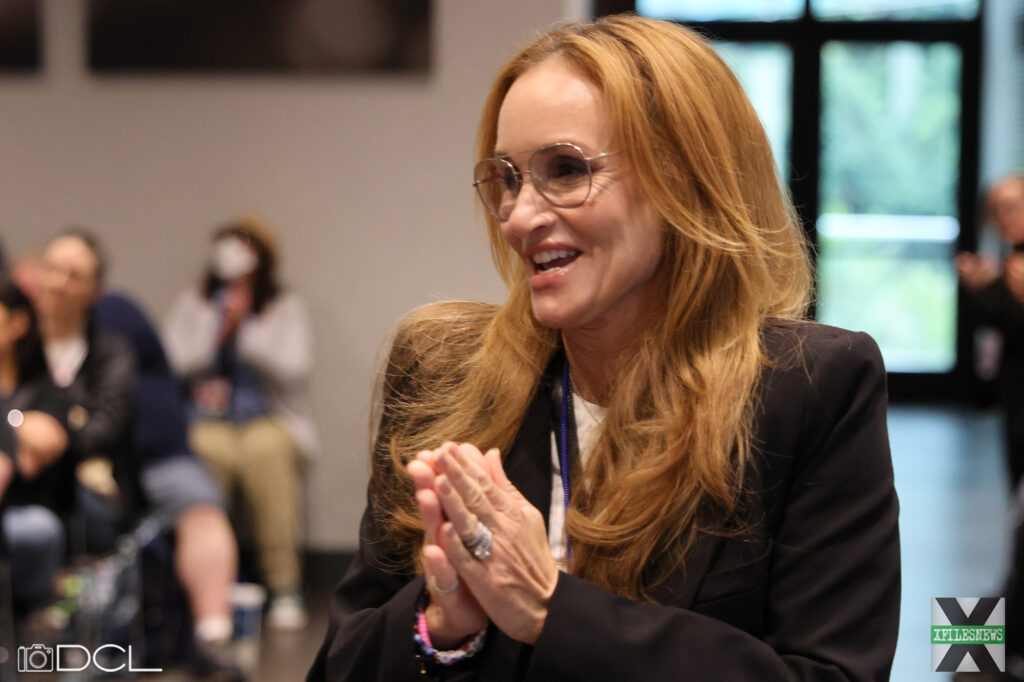
(Photo of Kristen from PhileFest, from X-Files News)

https://xfilesdiaries.libsyn.com/145-interview-with-kristen-cloke-morgan

Interview: James Wong

A great, comprehensive interview with Jim Wong courtesy of the the X-Files Diaries podcast! There’s a lot here about his work on the revival. Frankly, looking back, his work resulted in the revival’s most solid episodes, especially his episodes “Founder’s Mutation” and “Ghouli” that make up a sort of “parallel mythology” and a preferable alternative to Carter’s “Struggles”. Highlights and [own comments] below:

The early years:

  • The writers were given accounts by Fox on alt.tv.x-files, he posted a bit
  • They wanted to reverse the Mulder-Scully dynamic towards the end of the first season, but they ended up doing “Beyond the Sea” earlier because of fan criticism of Scully’s skepticism.
  • In the early years they didn’t want to do the relationship bullshit, not to do what “Moonlighting” did, what Fox was telling them to do, what everybody did. A non-romantic relationship was something to be celebrated back then. But Duchovny-Anderson had such great chemistry, you wanted them to. What’s right is how it ended up happening, over the years. [I like how he expresses this, I agree on both the noromo beginnings and the long-term evolution]
  • Standards & Practices were more on them during the first seasons, they could push back after they were a big success. Editing for “Home” was down to frame by frame. Jim & Glen were planning to do a sequel with the Peacocks in “Millennium” for the sweeps period, Fox TV head Peter Roth said no. The V-Chip [blocking TV set based on violence ratings] was passed in Congress because of “Home”. [It possibly had an influence, but the timing doesn’t quite work: “Home” aired in October 1996 and the Telecommunications Act was voted in January 1996, but started getting implemented in 1997.]
  • “Beyond the Sea” is his personal favourite. In San Diego, a local channel Z had “One Flew Over the Cuckoo’s Nest” on repeats, he saw it thousands of times with Glen Morgan, hence Brad Dourif. Dourif’s audition didn’t go well but (casting director) Rick Millikan and he and Glen pushed for him, Jim & Glen even paid an extra fee from their pocket, and Dourif did it.
  • “Clyde Bruckman” is another favourite.
  • When they returned in season 4 Carter asked them if there was anything they wanted to do, he asked to direct an episode. He was very nervous, he had only done 2nd unit directing in “Space: Above and Beyond”, he was more prepared for “Musings” than anything else before or after (shots lists, camera angles). He attributes his whole directing career to TXF. So he said yes to the revival. [“Musings of a CSM” is one TXF’s best for directing and photography, amazing that it was a first effort! ]

“Founder’s Mutation“:

  • He hadn’t followed the show after he left [back in s4!] but he knew that William was a mystery, that’s what excited him.
  • It was meant to lead into the finale. [The episode airing was reordered at the last minute]
  • He remembers shooting with kids in make-up: show as little of the monster as possible, a lesson from “Alien”.
  • Approaching the show all these years later, he found he had grown older together with the characters, he wrote the characters to be emotionally in the same place as he was, at a different age.

“Ghouli“:

  • It was born out of the idea of the final scene, to have Scully interact with her son without her knowing. [A highlight of the revival!] He wanted both to allow Mulder and Scully to grieve for their son [their son!], and to connect with him.
  • There was no writers’ room, there were no discussions, it was just him. [A method that has given both good and bad results!]
  • It was a kitchen sink episode, throw in ideas and do fun cool things: he wanted a crazy teaser, he saw the rotting ship and thought it would make a cool set, let’s get Scully shot.
  • He gave much thought in how do we find out about William, what do we see in his room, important for him to have the Asian man. 
  • There were no discussions with Carter about William, he became what Wong wanted to tell the story. About William’s character: kids do stupid things with their powers. [I find it nothing short of incredible that it happened like this, with Carter clearly wanting to do something with William for years, and did reuse Wong’s William in “My Struggle IV”. But you could argue that it’s a creative process like any other, have one person write part of the story and come in and continue it with your own ideas.]
  • His own ghost story! He went through sleep paralysis while shooting a film in Mexico. [Most likely for “Dragonball Evolution”, which filmed in Mexico.] He felt there was somebody in his hotel room all night through. In the same hotel, Rob MacLachlan [director of photography in Millennium] felt the same! There was a plaque next to the hotel, about a nun during the war who fell in love with a French soldier, committed suicide, people see her ghost every full moon. He discussed with Ghouli director of photography Craig [Wrobleski] on how to show sleep paralysis, to get one plane in focus and the rest out of focus.
  • He talked to Carter about what had happened with William, he gave him the cliff notes of season 9, there is a connection with Scully, he gave him carte blanche. Everything else (adoptive parents moving from the countryside to the city, Project Crossroads…) is all Wong’s.
  • About the intervening years since s9, he agrees with fan theories about: William/Jackson’s parents must have figured out something was going on with him, they could have sought help, enrolled him in a program, exposed him inadvertently to forces looking for him. [We can find traces of all of this background story in Ghouli.net, so maybe he did have some input to that. I still find the Wyoming/Virginia move to be a stretch, and Project Crossroads to be an unnecessary complication on top of an already complicated status for William’s powers.]
  • He wanted to write a poetic ending to the episode, he would have been satisfied if it was the last we see of William. He didn’t know what Carter wanted to do. [Looking back, I would have been fine if Ghouli was the end of William’s story, but during s11’s airing it was already clear that we were going to see him again. Somehow Carter short-circuited Wong’s intentions.]
  • Design of Ghouli: this was all Bill Terezakis.
  • Ghouli.net was Fox’s idea. Julie Ng and others did the writing, he didn’t. [More kudos to her! So many good ideas in there.]

“Nothing Lasts Forever” [Wong directed only]:

  • Last scene: he doesn’t know what Scully whispered to Mulder, he thinks she said “it was always you”, the candle was an affirmation of their relationship.
  • Kate McKinnon was an XF fan, they tried to cast her as Barbara Beaumont, but it didn’t work out.
  • Glen Morgan also hung out on newsgroups back then, it was really new to have live reactions from the audience then, there was criticism but no trolling or personal attacks. He didn’t go online after his revival episodes. [Understandable. Here’s to constructive criticism.]

https://xfilesdiaries.libsyn.com/143-james-wong-interview

(Photo from PhileFest by X-Files News)

https://open.spotify.com/episode/47XTqXmGTIQSeQIExNvvm4

Interview: Julie Ng

Listen to these two podcasts featuring Julie Ng, an alumnus of Glen Morgan’s and the producer of all the behind the scenes content for the two revival seasons — lots of great little info on the making of the fan-favourite and light-hearted “This”. Confirmation that plenty of dirty and kinky lines were ad-libs on the spot by the two lead actors, which reinforces the impression that in this episode we are seeing more Duchovny & Anderson rather than Mulder & Scully per se. I didn’t know the Ramones’ “California Sun” was a cover — another R&B classic stolen by a rock band!