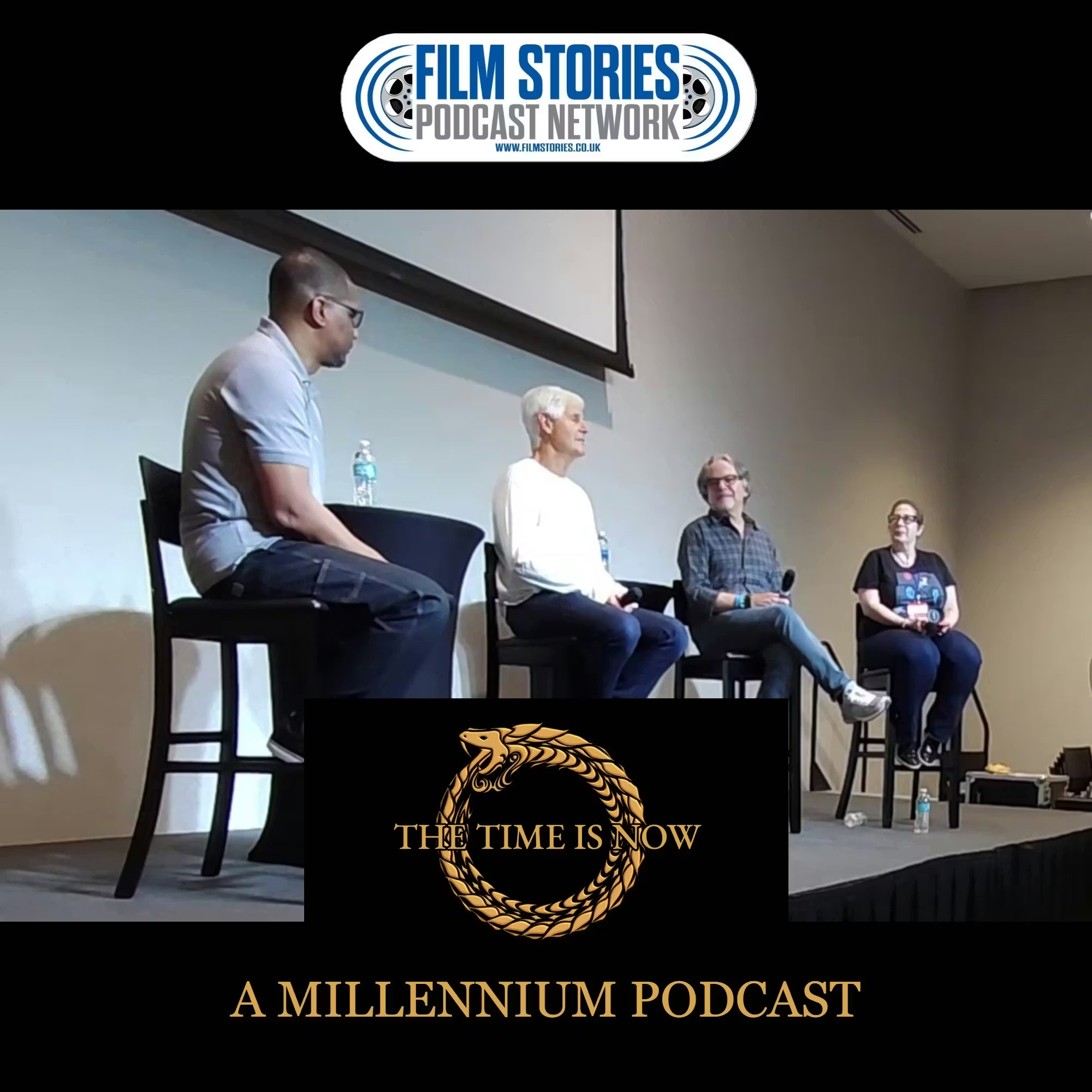
Somewhat recently, already 4 months ago, a recording of the Millennium-focused panel surfaced, thanks to Kurt North from the X-Cast / The Time Is Now podcasts. This is the only panel from Philefest in September 2023 that had not been recorded by X-Files News, I suppose because it was not about The X-Files. The panel had Chris Carter, Frank Spotnitz and Troy Foreman (producer of the Millennium documentary). Though short, this panel is excellent, on several points Carter has humorous comments followed up by very heavy stuff, and we finally got a good reason why MM is still not on any streaming platforms. Here are the highlights:
Carter: The idea for MM came from Fox forcing him to come up with a second series! He was a big fan of “Silence of the Lambs”. He finds Fincher’s series “Mindhunter” excellent.
Spotnitz: TXF episode “Irresistible” was an early template for MM. Among all the hours of TV they did, the Pilot of MM is the best. In the Pilot, the characters, the ideas are “closest to who you [Carter] are, closest to your worldview”. Carter does believe in the evil of the world, but we all have yellow house. There were no supernatural monsters or aliens like in TXF, it was the reality of the human condition.
Originally two highly qualified executives had been hired to run MM [who?], but Carter and Spotnitz had to take over. There were 1500 people working daily on TXF, MM and the TXF movie, it was amazing they pulled it off.
Why don’t we have MM on streaming? Season 2 has a lot of good music and securing music rights is costly. Carter: Disney/Fox is “cheap”. [Finally, an answer! Hold on to those DVDs!]
Season 3 was run by Ken Horton and Chip Johannessen, they had plans for season 4, but Carter and Spotnitz don’t know them, don’t know what was Peter Watts’s fate. Fox would have done a season 4, but Carter moved MM aside to do “Harsh Realm”. Fox was chasing better ratings, but the ratings never got better than MM, it was a structural decline.
Carter: “I’ve met evil people”, “some people have a defect”, “too many of them are lawyers”, “I know the face of evil, I’ve looked it in the eye and shuddered”.
The reason Carter took a break after TXF was an on-set accident where a crew member electrocuted himself and was killed. [This was Jim Engh; 8X01: “Within” was dedicated to his memory.] He went to the funeral, he met his widow. Later, the widow was suing and Carter was named specifically. He was called in for a deposition, the lawyers were trying in every way to connect the deceased with him. He had enough, he didn’t want to put himself in a position to be accused. Eventually the case was dropped. [These are rare details on a little-known case, and a surprising amount of detail. Along with a work burnout and other legal issues with Fox, this was certainly a contributing factor for Carter’s break after 2002.]
Question about common visual elements between the MM pilot and TXF: “The Red and the Black” (people with sewed orifices in their faces): Carter: both were made concurrently, it was not conscious.
Spotnitz: Carter loved Fincher’s “Seven”. He got “Seven”‘s assistant production designer for the MM pilot. [This was Gary Wissner, credited as art director on “Seven”.]
MM revival: the obvious way forward would be if Jordan has similar gifts and becomes a serial killer profiler herself. Carter: the number of killers has decreased in recent years, one would have to branch out for new stories. “Dahmer” was great.
Sarah Jane Redmond originally approached Carter for a role in MM. She had the perfect affect for MM. Carter wrote the Lucy Butler role for her.
In the MM documentary, the interview with her took place inside a church.
Spotnitz: originally the show would not have any supernatural at all. The studio was pressuring for it. By the end of season 1 they did “Lamentation”. Lucy Butler was Spotnitz’s favourite character after Frank Black.
What do they fear now? Carter: “the Trump administration”. If they’d do the revival, a scary title would be just “Trump”.
Season 2: Glen & Jim had ideas, they took a huge load off Carter & Spotnitz. He watched the season like a fan.
Spotnitz: he was exhausted after season 1, it was brutal. Carter asked him if he wanted to leave TXF for MM. It was a hard decision.
For season 2, Jim had T-shirts printed out “99% less serial killers”. It was a different direction.
Season 3: Chip was a poetic, artistic writer. It was a different tone and focus. Carter & Spotnitz came in and contributed, but it was Chip’s vision. The show was 3 distinct visions, a triptych. Spotnitz loved the work of Kristen Cloke.
On TXF: “The Erlenmeyer Flask”: the hybrid idea was something Carter and Anne Simon hatched together. Carter follows current research on genetic engineering, “we are on the cusp of changing the human race”.
Spotnitz: on the Scully effect. MM’s casting was diverse: it was not a calculation, it was not pandering, it was resisting pressure about ‘where’s the sexual tension?’ (regarding the Emma Hollis-Frank Black relationship). It’s amazing how well MM holds up. “That’s Chris’s respect for women.”
Carter: on female producers in MM. TXF had more female than male producers, he is super proud of that. He took offense with some comments in seasons 10-11. He tried to hire a female director of photography for TXF, Sandy Sizzle, which was rare at the time; Fox’s Charlie Goldstein said ‘no way’, that women couldn’t lead a crew. [This whole bit sounds like an organized defense of their work in response to criticism Carter in particular has received, and it looks like it has touched a nerve! All of these are good points but this is somewhat misplaced: I think the criticism has centered around the writing staff, which was nearly-entirely male for TXF and admittedly more balanced in MM. Also, there are many behind the scenes things we are not aware of and now that so much time has passed Carter is opening up a bit, it’s not usual for him or in the industry to be naming people like this.]
The leads of MM, Lance and Megan, were their first choices, no auditions, they gave them the roles based on past work. Megan had a unique intelligence and humanity. Spotnitz: when they killed Catherine he was sad and disappointed, it was not his decision.
Speaking of which: an extended cut of the Millennium After the Millennium documentary is coming on April 7 on BluRay and streaming (Amazon Prime)! (I don’t know if this will be available globally on Prime, it wasn’t in the past.)
Ten Thirteen’s fourth series, The Lone Gunmen, first premiered 25 years ago, six months before 9/11/2001 — with that now infamous pilot episode that involves a false flag operation from the US military-industrial complex to fly a plane into the World Trade Center and increase arms sales in the aftermath. The series would go on to be much more humorous after that pilot, with a type of humor that was not to everybody’s taste, more like some season 6 episodes than Darin Morgan episodes, but the photography and the Vancouver setting were unmistakable Ten Thirteen. It premiered during The X-Files’ season 8 and lasted half a season with 13 episodes. It was not picked up for a season 2 and the series would be given a finale with the controversial “Jump The Shark” in TXF’s season 9.
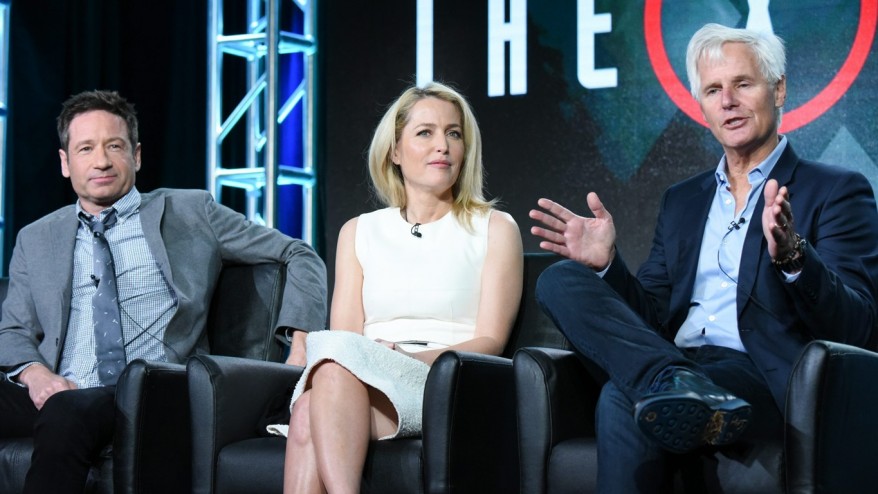
The Television Academy has an interview with show co-creators Vince Gilligan and Frank Spotnitz (the third member of the John Gilnitz trio, John Shiban, is missing!) to reflect on the show. Here are a few highlights:
Spotnitz: I actually think we wanted to do The Lone Gunmen [earlier] and it was delayed by Harsh Realm.
Spotnitz: I also think, looking back on it, it was season eight of The X-Files — we had already hit our peak, and we were already on the way down in terms of the mania for The X-Files. It was probably two or three seasons too late to do that spinoff. If we had done it in season four or five [during The X-Files’ run], we might have had a different reception. 9/11, in my view, really killed The X-Files. The mood of the country was no longer government conspiracy and all that.
[Entirely agreed that the spin-off came too late. The Lone Gunmen-focused episodes of TXF were during seasons 5 and 6, and this is when a spin-off should have started.]
[One thing that neither of them mention is that TXF season 8 was given a break between airing “This Is Not Happening” and “DeadAlive” in order to accommodate the first episodes of TLG. To introduce a break during what was perhaps TXF’s peak emotional moment and have viewers follow a humorous spin-off was not the producers’ best decision, and probably hurt viewership too. Of course all of these are past considerations, things would have gone very differently with today’s streaming format, and TLG is the kind of niche show that might have found its audience eventually.]
[I think this is the first time we hear that it was delayed because of “Harsh Realm”. As good as that one was, we can now blame it for first cancelling “Millennium” season 4, and for postponing “The Lone Gunmen” further into an untimely period.]
Spotnitz: There’s a story I’ve never told, but I feel like I can tell it now that it’s been 25 years and Fox has been sold to Disney. The deal that Tom and Dean and Bruce made — Fox screwed up. They paid them way more money than they meant to pay them. So, when the show got canceled, Vince, John, and I wanted to have a sendoff for them. We wanted to write “Jump the Shark.” Fox did not want to bring them back. They really tried to stop us; they were so mad. In their mind, they’d overpaid them for The Lone Gunmen. They were absolutely against it. And we just said, “We’re doing it, so you’ll have nothing to broadcast if we force their hand.”
Spotnitz: I do regret that that episode didn’t end with a laugh — it just ends with sadness. That was a mistake. If you’re going to do that, then you’ve got to bring back the joy that the characters represented, and we didn’t.
[Spotnitz said in the “Jump the Shark” DVD commentary that Fox was very difficult an only gave them the greenlight to do the episode when they decided to have the Lone Gunmen die. It was a heroic death all right, but this gives a whole another vengeful layer to this: the Lone Gunmen died because of some clerical error!]
Gilligan: I’ve said this a lot: You don’t know if it’s going to be hit. You don’t know if it’s going to be a failure. That’s what keeps it interesting and keeps your guts churning.
Gilligan: You don’t learn anything from success. And I’m not being funny, I’m being 100% serious. When something’s a success, you try to say, “It was because of this, it was because of that.” But you’re always wrong. There’s nothing I would call a mistake about The Lone Gunmen — not even time slots or any of that. You just do your best, and everybody did their best. I’m as proud as I can be of The Lone Gunmen, and to this day, I’d love for people to [read] this and say, “What show are they talking about?” And then look it up online and buy it. We put out DVDs.
Gilligan: We were lucky to get 13 [episodes]. Nowadays, it’d be six. I just couldn’t be more proud of it.
[I personally don’t think “The Lone Gunmen” was a very strong show, especially because of the way it handled its humor, and I’ve always thought it would have been a stronger show if it had half-hour instead of full-hour episodes. Given the quality work that Gilligan became famous for, it’s interesting that he still defends “The Lone Gunmen” so earnestly. It is undeniable that that show had a lot of heart, both in front of the camera and behind it. It is true that the popular success of a show relies on many factors that are conjunctural and difficult to pin down or purposefully recreate. Let us think about that when we consider the successes and failures also of TXF’s revival seasons, or the potential success or failure of the proposed TXF reboot.]
Let Gilligan have the final words about “The Lone Gunmen” and its heroes:
Gilligan: It’s just timely 25 years later. We need The Lone Gunmen more than ever. Three guys who, trying to save democracy, save the rule of law. God bless them. I want to think they’re still out there somewhere.
The X-Files revival is already a decade old! As incredible as that sounds. “My Struggle I” premiered on January 24, 2016; followed by “Founder’s Mutation” just a day later. A decade later, Chris Carter is still preparing new things for the world of The X-Files. Here we break down his latest interview, the last interview of The X-Cast podcast, recorded on November 23, 2025. After hosting academic-level analysis of TXF and bringing us dozens of interviews with cast and crew, the X-Cast ran its course and finished its notable run (I even sent them an audio message for their last episode!). But Carter is not done with the show, and he even looks forward to more interview with them despite the fact he was told that this was for the X-Cast’s closing salvo. It feels very weird listening to this interview: on the one hand it feels like the ending of an era, with the revival being as old as it is now, and with these dedicated fans calling it a day; and on the other hand Carter opens up so many fronts that it’s impossible even for the most jaded fan not to be excited for the future.
“I Want To Believe” Director’s Cut
As first announced on David Duchovny’s podcast, an all-new cut of the second movie is in preparation.
Carter is exchanging notes with Garfield Whitman; he was post-production supervisor in Carter’s “The After” and an associate producer / co-producer for both TXF revival seasons. They have a finalized cut and sending it to studio imminently.
Carter and Spotnitz loved their script. The studio asked them to make a change; to get the PG-13 rating they had to take out several scary things and part of the story. Then the Motion Picture Association asked for more cuts. Carter found out that the PG-13 rating on theatrical movies is less permissive than network TV.
The story is an “homage to Frankenstein”. He had heard that a doctor in Cleveland had done a transplant of a monkey’s head. He visited him for research. The equipment in the lab in the movie would have been what would really have been used from that operation.
The Mulder-Scully relationship went through an “interesting wrinkle” in IWTB. Mulder and Scully never got married. [A thousand fanfic writers cry in agony!]
He remembers lots of shooting in the snow. With the director of photography, the did tests using digital cameras, but the snow was blurred out, so they decided to shoot on film.
The distance from it since 2008 makes him look at it with fresh eyes. He lifted some things, rearranged a couple of things.
He is working with the “best editor I’ve ever known”, Eleanor Infante, it’s “her version of the movie”; she worked on season 11, and with Carter on My Struggle IV (here’s a recent interview with her). They have added effects and music. Changes are sprinkled throughout. The new cut has “made it lean on the story rather than completely on the relationship.”
“It was not the movie we set out to make”, “it was always a disappointment”. [!]
His wife has seen the new cut, she is his toughest critic.
There is not more Skinner in it.
They have access to Mark Snow’s music library from the show, they are drawing from it for the new edit. “Mark Snow MS is TXF”. Carter talked with him shortly before he died, his diagnosis was terminal. [Nice to hear him talk about Snow, finally.]
They are on a tight budget. He wants to add two contemporary songs in the edit, and they are expensive.
It’s impossible to say when it will be released. [Or how? Could Disney/Fox be planning this as a tease before the premiere of Coogler’s TXF series?]
[This cut is more than the already-existing IWTB extended cut (in the DVD/BluRay), it is much more than either reverting to an earlier cut before the changes demanded by the studio (see “Blade Runner” Final Cut, more or less), or taking extra scenes that were shot and adding them in (see “The Lord of the Rings” Extended Editions): it is an all-new edit with new sound mix based on the same raw material, with a different editor and a director who is 17 years wiser. This is closer to “Caligula” Ultimate Cut, you could say, and rather quite unique in movie history. Now, I don’t know to what extent the additions will make me have a complete change of opinion on the entire movie. But we are not talking about just adding in more violence, and indeed some additional story is very much welcome. Surely it bodes well for making the movie at least marginally better! I will look forward to this. What is most surprising out of all this is Carter’s admission that the 2008 movie was a “disappointment”: a very rare admission and an example of self-criticism that is not Carter’s forte, as we will see in what follows.]
The 2016-2018 reboot
The reboot came about not with Carter going to the studio, but with the studio approaching him and the actors first.
“Darin’s episodes were fantastic” (if they could have done more, “my answer is always more Darin Morgan”!), “Glen [Morgan] and Jim [Wong] were great to have”. Frank Spotnitz was busy in Europe. Great to have newcomers like Ben van Allen, who did a horror movie type episode [Familiar].
Series today have the luxury of having all scripts ready before shooting, they didn’t. [S10-11 were produced in the ‘old style’ of network TV, like the original series in the 90s.]
A writer wrote an episode but it wasn’t TXF, Glen jumped in and wrote a fantastic ep. [He won’t say which writer it was and which episode Glen replaced. “Rm9”?]
The studio thought of reordering the s10 episodes. He didn’t disagree, but it was not a popular decision.
About “Babylon”: “Miller” is Mulder in Dutch, and David’s son is called Miller; “Einstein” fits with Scully’s science background. He anticipated the question on whether this was a backdoor pilot; but there was no time nor the opportunity to discuss anything more than what they did. He has friends who have done MDMA or ayahuasca, they have come back changed; it was fun to see Mulder do something like that with his mushroom trip. He is a fan of Fatboy Slim’s video clip with Christopher Walken [Weapon Of Choice], wanted to see something similar.
“My Struggle I” was written 2015 before Trump and it “predicts the conspiracy-laden crazed world world as we live in today”. He had been going to conspiracy theory conventions, he saw what was coming. “My Struggle II” predicted the pandemic.
The revival is “good”, “the work is great”.
[While there are certainly good things to say about the revival, and 10 years passing has already started doing its work in terms of re-evaluation, I still wouldn’t call it “great”, especially where the mythology is concerned, which is entirely Carter’s doing. MS1 might have thrown the viewer into a whole new world of crazy conspiracies, especially with that scene where Mulder and O’Malley are trying to one-up each other at the most out-there conspiracy theory, but the show didn’t do anything that was narratively interesting out of this mess. At the time in my review, I expected the confusion in MS1 to correspond to Mulder’s state of mind, hoping that subsequent episodes would develop this, clarifying the lies from the truth, becoming specific rather than vague, producing a plot that says something and brings change into the characters; what we got instead was a mere statement, a mood, and stopping there, on to different things in every single Struggle. Clearly, Carter is not one that relishes the current state of things under Trump, the MS1 conspiracy overload was a warning that paranoia would be our undoing, not that all conspiracies were premonitions. As a result, bona fide right-wing conspiracy theorists took MS1 at face value and felt vindicated that their world view was becoming mainstream; MS2 did little to correct that.]
[Of course an author doesn’t have to share his characters’ opinions, as in any work of fiction. There is this whole reading of the Struggle episodes about subjectivity: paranoia in My Struggle I (Mulder), lots of science in 2 (Scully), lies / cover-ups / self-aggrandizement in 3 (CSM), and whatever 4 was (William). And indeed these episodes become more interesting once you perceive that, they are complex episodes. However, at some point you have to tell a story, some story: you can’t have absolutely nothing happening in an objective shared reality and impacting character motivations, decisions, actions following one another, plot. So the Struggles-as-subjectivity was a nice experiment, but that reading can only hold to a certain point.]
The “My Struggle IV” clue and season 12?
About the 4 “My Struggles”: “they were all aiming at season 12. Whether that happens or not I can’t predict. I can’t think of any bigger things that I’ve set up through the course of those 4 episodes than I’ve done in the show previously. I’ve got big ideas. I certainly would love to see those come together as a series or as another movie. We’ll see.”
Theories about what the clue about the continuation could be (the host Kurt throws several theories at him: that there is no real savior, everyone is their own savior; that Scully’s pregnancy was the first stable inherited hybrid; and Eat The Corn’s own elaborated theory was quoted to Carter, that William can perceive the “music of the spheres” and have access to timelines and can change the future): “all of that plays into the culmination, I put a big clue in there and no one has really — not even responded to the clue, haven’t seen the clue. That clue is staring you in the face, it plays into what TXF will or will not become in the future.”
There was a “not pleasant exchange” with Gillian, she felt Scully didn’t have agency. “The pregnancy came out of the blue for her, which it did, because it came out of the blue for me too.”
There were some angry fan reactions after the finale: “It showed me I hadn’t done enough to convince people what I’m doing. I’m doing this organically, its not like I — all has to do with the show and what came before it, but I’ve got a big idea, a lot of people didn’t see it that way.”
[I was excited at building up that theory collecting quotes from various of his theories, and I must say I was disappointed not at the fact that it’s wrong, that’s fine, but more at his whole attitude. It’s amazing to me how he persistently teases us with this big clue for well over a year now. Despite being directly presented with the most meticulous fan-made theories, his reaction is just the spiel as if he hadn’t heard anything, that there’s a clue that somehow absolutely nobody has thought about or even come close to. Is he taking us all for a ride just to stir interest in making more episodes? It just never ends and there is no catharsis, if season 12 is made there will always be season 13 to tease afterwards. And when the journey is so frustrating I’m not sure I’m interested in the destination.]
A third movie?
Carter was discussing with 20th Century Studios President Steve Asbell about a possible third TXF movie. That’s when the idea to do a director’s cut of IWTB first came about, it came out of the blue.
David Duchovny and Carter have been “talking about something new for quite a while”, something involving both Duchovny and Anderson. All three were going to have lunch together on December 1 to discuss this project.
All this is separate from Coogler’s project. Carter gave his blessing to Coogler, it will be his own thing. “I’m curious what he’s going to do.”
There’s a lot of new science he wants to write about in new episodes.
About continuing the story in other media: Others come to him with project and ask him if he wants to collaborate. “Perihelion” book: “I think she did a terrific job.” The cancelled TXF animated series “didn’t happen, I think I made the right choice” [to cancel it]. “I don’t think we’ve seen the end of these characters in the medium we’ve come to know them.” [i.e. live-action] “These characters and the show are so personal to me, I want to protect them every way and every time I can. I don’t want to have them become irrelevant because there’s so much of them, so I’m reluctant to — although there are opportunities like the Coogler series.”
In IWTB there are “all those little things I laid in there, on the wall, the back of Mulder’s door at home, little things that meant something to me, now I have the chance to — there’s more to see.” [Is this about the elements in the new cut, or that IWTB includes hints about what comes next that will become clear later?]
[So not only the story of TXF is not over, he actively has plans for a season 12 and a story idea for a third film, all in parallel to Ryan Coogler’s potential series. This is huge! Is it 2008 all over again? Time to resurrect the #XF3 tag. Mulder and Scully are off-limits to Coogler, at most there could be a cameo for them, and we can call this project a “spin-off” of the main series. Mulder and Scully are ‘reserved’ for whatever Carter (and Duchovny) have in mind. I understand that will to “protect” the characters: Carter has poured so much of himself in this world, his worldview so unique and so closely associated to the TXF identity, that it’s difficult to imagine TXF without him. Despite everything I’ve just said about his revival episodes (and my head-canon still stops after season 7), I will always be interested in what he does. I genuinely hope he proves my negativity wrong!]
[But is he reading the room well? How likely is any of this to bear fruit? Is one re-edited movie that carries a lot of lukewarm baggage enough to trigger financing for a new revival? Coogler’s project has an uphill battle to convince a new audience that it will have an identity of its own and that it can stand on its feet, and the studio and Disney will focus their marketing on that new thing instead of a return to the old. So will we ever know what Carter intends? His approach to hold everything hidden is very different to, say, Daniel Knauf revealing planned plot points for “Carnivàle” or James Cameron saying he would be ready to publish everything in a press conference or in a book if no more of his “Avatar” films are made!]
Misc and non-TXF projects
He is about to embark on a new directing project. His wife wrote something about 35 years ago, it was optioned but never made. He found the script in their closet. She has updated it. They have found the perfect actress for it, it will excite TXF fans. They are now searching for investors for it. [I hope he manages to do it, just so that we can see more of his work being made and break his ‘single-success man’ image.]
“I have an idea right now that is kind of my answer to the criticism of ‘The After’, it may see the light of day someday.” [Another story idea, another thing I want to learn more about!]
The logo: the “typewriter X” was created by himself. The “X” used in “Fight the Future” was made by others; but he “has ideas about” that logo for the future.
His advice to young Carter writing the TXF pilot in 1992: “You’re lucky you didn’t listen to your mother, who said you don’t know what a hard days work is!” They worked a lot for the series! “My forebears were dairy farmers who got up at the crack of dawn to milk the cows. I was the same person, working on a science fiction TV show.”
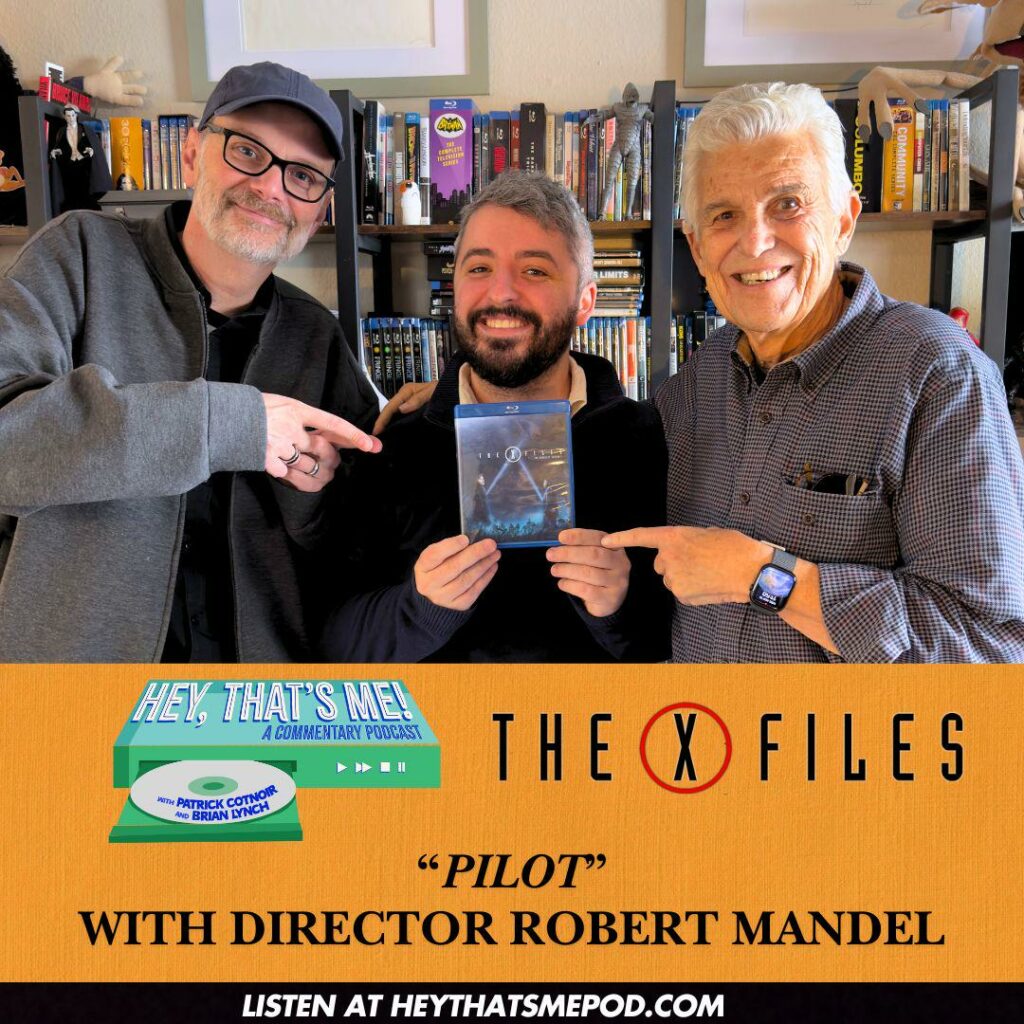
Happy solstice! Here is something out of the ordinary: an interview with Robert Mandel, the director of The X-Files pilot episode in 1993, by the people at the “Hey, That’s Me!” podcast. This is I think the only interview he has ever given on TXF, he is somebody who goes from project to project and doesn’t look back. The pilot is of course full of iconic moments and it is still very well-remembered. He only did the pilot but he sounds like somebody who could have been a good fit for the show long-term.
The episode runs like a live commentary on the episode itself. Some highlights:
Before, he did a lot of theatre, then AFI, short films, then features. This was his first TV experience, he wanted to do more movies.
A great experience overall. He and Carter were in complete agreement.
He had seen “Prime Suspect” [1991 TV movie with Helen Mirren, police investigation on serial killer with the lead dealing with workplace sexism], he discussed it with Carter and they wanted the same approach for TXF, low-key mystery, play it straight.
He came in when Mulder had been cast, they were still looking for a Scully.
Carter was more familiar with TV production than him. As writer and producer, Carter was on set every day, but the cooperation with Mandel went fine, there was trust.
He specifically remembers shooting a lot of dialogue under the cold and the rain, and Mulder talking about his sister, working with director of photography Tom Del Ruth [also only worked on the pilot].
Tight shooting schedule, hardly any time for rehearsals. Now pilots get more time.
They did 5-7 takes, tops; anything more than 3 takes was a lot already.
Carter liked people sticking to the script.
Carter found a lot of the set dressing himself, like Mulder’s wall. He worked a lot on the Pentagon set, for him it was key.
He and Carter showed the pilot to two executives. They expected or wanted more humor, they were looking at each other, trying to anticipate the audience reaction.
They really didn’t expect success, even after it came out.
He thinks Carter was genius keeping Mulder and Scully apart.
On the monsters-of-the-week: “Chris would’ve done UFO episodes every week. The network didn’t want that. They wanted a monster show. I remember being in the office late at night — which was like a box; it was just a dump on the Fox lot — and we’re just sitting there trying to think of ideas.”
On 1X02: Squeeze: “Regarding the 30 years, my brother told me, “I think that you stole a Night Stalker. There was a thing where there was a guy who comes out every 30 or 50 years.” I’m like, “What?!” We loved that show with Darren McGavin. The episodes weren’t readily available until recently, so I don’t know if I lodged that in my subconscious. Chris had been in France, and he was fascinated by how they make foie gras, so that’s where it came about that Tooms ate livers.”
On 1X20: Tooms: “Skinner was named after my mom’s friend.”
On 1X07: Ice: “When I was a kid, there was an unknown movie called Report to the Commissioner, and at the end of the trailer, the two people were in an elevator with guns on each other. That image had a big effect on me — so let’s do that!”
On 1X12: Beyond the Sea: “we wanted to introduce [Scully] to the possibility of a paranormal event. We felt that the one thing that people might be open to is wanting to see a loved one that had moved along. The experience has a great deal of watching my mom when my grandfather passed away.”
On 2X14: Die Hand Die Verletzt: “John Bartley was the director of photography, and he lit that fourth act essentially with two flashlights, which were I think $3,000 each and the wire went up Duchovny’s coat. It was not done on TV where an entire act was just that level of darkness.”
On 4X03: Home: “My grandmother and grandfather, my mom’s parents, lived in Rochester, and they had a family next door who was a very nice family, maybe a little chaotic, named the Peacocks. I just thought, what a great name, and so we named [the “Home” family] the Peacocks.”
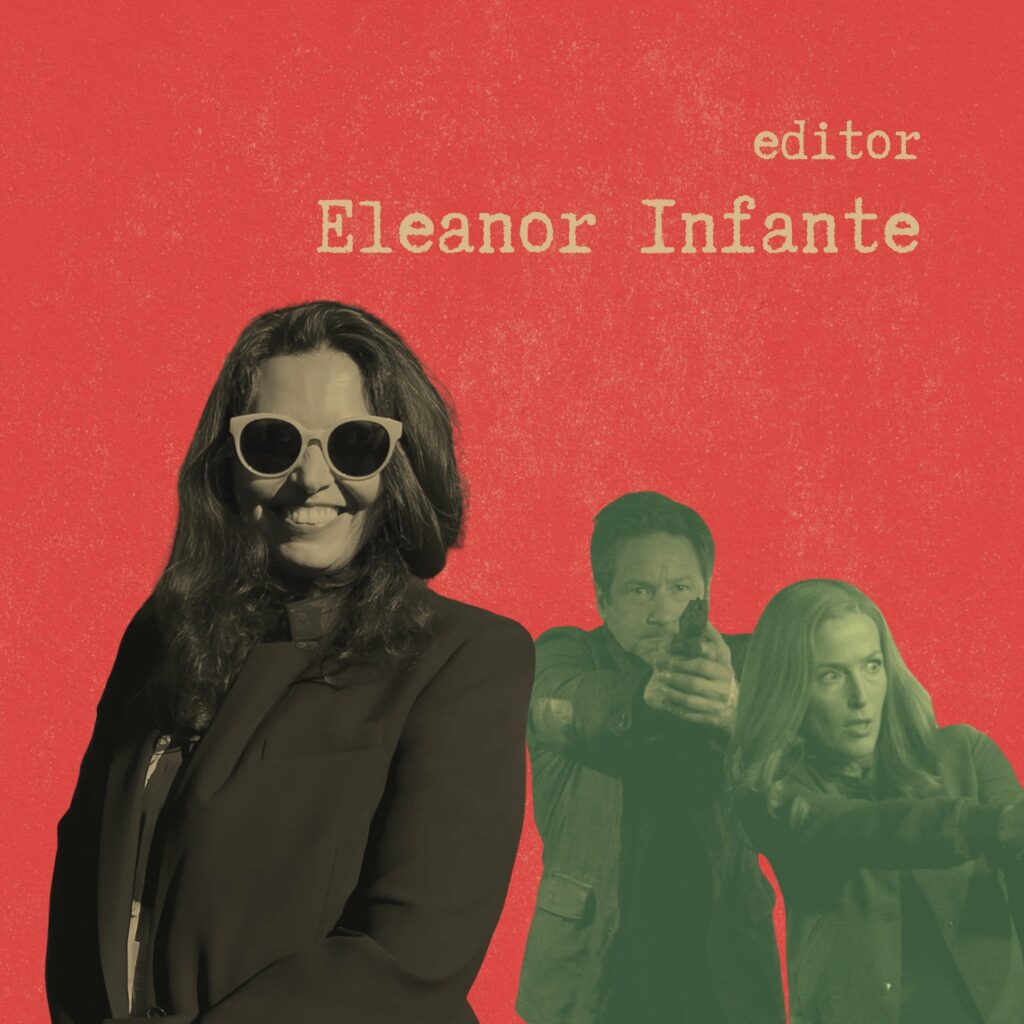
Still trying to catch up with recent interviews — here is one with Eleanor Infante, editor of 4 episodes in The X-Files season 11, with the “Hey Danny, it’s Mulder” podcast. Some interesting insights here:
She talks about working within the strict boundaries of length for commercial cuts in network television, as opposed to much more flexibility in streaming. [I think that can be negative as much as positive, as it inserts tightness in script and editing.]
Glen Morgan brought her to TXF. They did “Lore” together before (and worked on “The Twilight Zone” since).
She had never watched the show. As she was editing her episodes, she was watching a top 30 of episodes as per a list by Vulture.
Interesting difference in working methods between the two brothers: Glen lets editor give him what she wants, he is a collaborator, he takes what others suggest; whereas Darin is very specific about what he wants, she was a help for his vision.
11X02: This: for the group approaching the Mulder & Scully house in the teaser, Glen was inspired by Peter Weir’s “Witness”, with the dread of the cops approaching the Amish. He also wanted to use the Ramones song.
11X04: The Lost Art of Forehead Sweat: Darin is a perfectionist genius. He is all about language, rhythm. He sat with her and went through all the takes. She was the one who suggested to him that they use the a capella version of the main theme!
11X07: Rm9…/Followers: she had fun inserting draft sounds in the editing, Glen liked almost everything, then the sound department replicated it. The voice of the AI would have been Stephen Hawking himself, they were talking with his estate, but he was ill [he died just months later, in March 2018].
11X10: My Struggle IV: Build trust with the director-producer to take initiative, and move things around even if it was not scripted. She did that in this episode. Carter asked her to do an audio commentary of the episode.