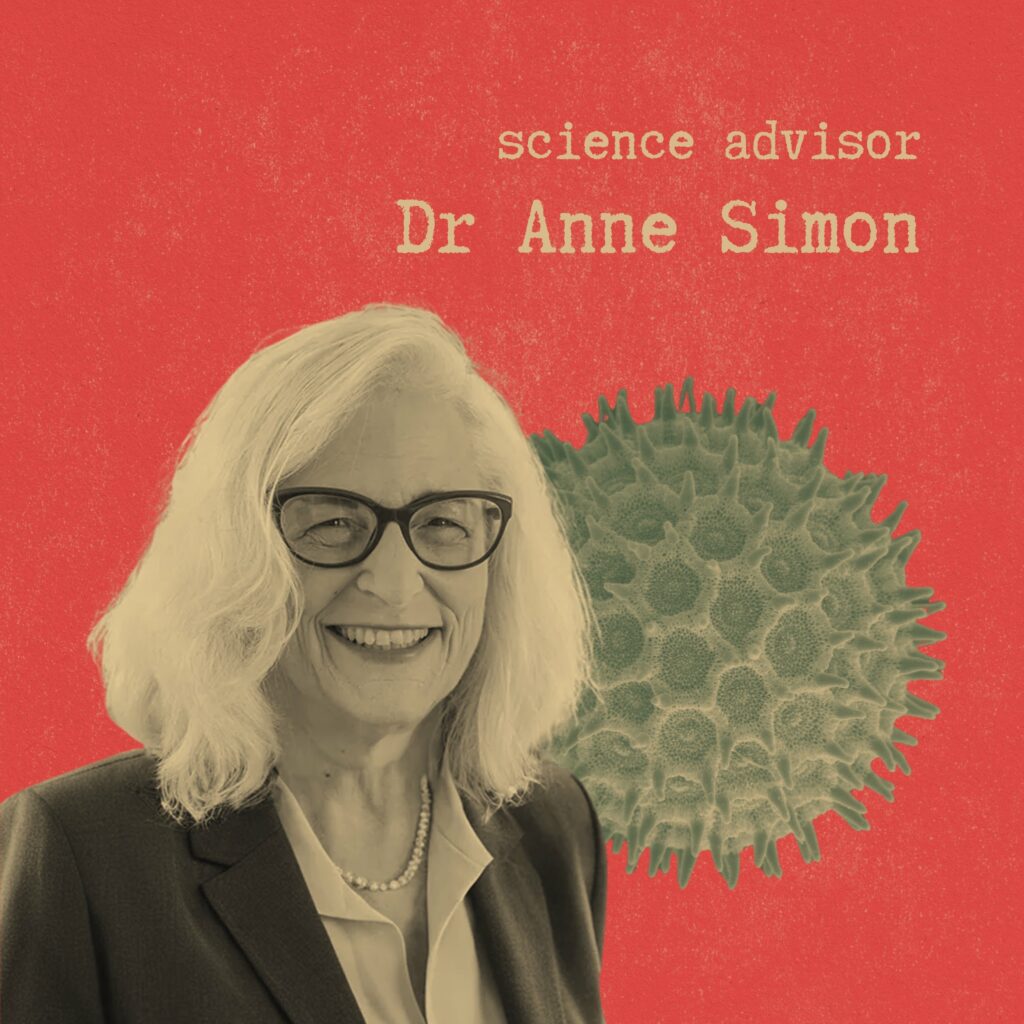
The “Hey Danny it’s Mulder” podcast interviewed Anne Simon, who was Chris Carter’s science advisor for much of the duration of the show and contributed with many realistic elements of the show’s mythology specifically.
What was discussed:
1X23: “The Erlenmeyer Flask“: plenty of contributions from her! The name of the episode itself, the solution contained in the flask that looks like “weak coffee” [“monkey pee” according to Scully], using an image of pollen for the alien bacteria, the two nucleotides as undeniable proof of alien DNA, the use of a scanning electron microscope, Carter naming the scientist “Anne Carpenter” after her…
4X01: “Herrenvolk“: using a real DNA sequence of cowpox virus just in case somebody would analyse it (which someone did of course!) to avoid having a random sequence like in Michael Crichton’s “Jurassic Park”.
5X02: “Redux“: the “blazing hot probe” story for the Southern blot test, which is normally done in two days but the script needed it to be done in four hours.
9X18: “Sunshine Days”: she and Margaret Fearon (TXF fan she met exchanging letters and became close friends with [a character in IWTB is named after her]) visited the set; they corrected several things in the set to make it more realistic (X-rays, position of the autopsied body, lab equipment…)
10X6: “My Struggle II“: all the details of CRISPR, Spartan virus (Margaret came up with the name), inserting the virus together with the smallpox vaccine, everything that got her and Margaret a writing credit for the episode. For the trigger for the loss of the immune system, she had many ideas around air pollution and climate change; but Carter wanted to use chemtrails specifically [it’s not very clear what the trigger was in the final episode].
[As noted in my My Struggle II analysis, this is all great science but it poses an issue of logic. It’s interesting that Carter asked them to come up with a way to have the virus and gene mutation inserted in all humans *specifically decades ago* and not recently: so the CSM’s Spartan virus plan was indeed set up a long time ago and that’s not a mistake or an overlooked detail. The CSM’s plan was in place decades ago, all the while the preparations for colonization and the hybridization experiments were taking place. This is all very difficult to reconcile: if the Spartan plan is in place and can destroy humanity, what’s the point of all the experiments related to colonization that we were presented for nine seasons?]
On scientists’ representation on-screen and scientists’ desire for a more realistic portrayal, on the Scully effect and the many times she became aware of it during her career.
But most importantly, Simon discusses the dire state of science funding in the new Trump administration, and how the United States is sabotaging itself by turning its back on science, and how a new generation of students is seeing its funding for research being taken away and its interest in science waning. [Progress based on science greatly helped make the American Empire during the 20th century. Now the situation is reversed and the US’s star, as a global beacon for people around the world and very practically as a leader of global affairs, is waning.]
More about Anne Simon on Eat The Corn:
Analysis of her 2001 book “The Real Science Behind The X-Files”, including things that might presage the Spartan virus [when will we get an updated edition?]
He hit it off very well with Chris Carter, he knew all about the sources for the mythology/conspiracy and the UFO lore. Both had seen a TV rerun of the “Mysterious Island” (1961) with Ray Harryhausen stop-motion effects which inspired them to get involved in the movie business. [I grew up with that movie too!]
Early on, Paul Rabwin was busy and Ken would be the one directing the insert shots; then he was stopped because he was not part of the directors guild.
It was shot on 35mm film. The mandate to all teams was to do work that would be worthy of a feature film. The props were made so they would hold up to high definition.
By season 5 the props team grew to 15 people, they had 1st unit, 2nd unit, an inserts unit, a photos unit. By then he’d rarely have the time to show up on set himself, he was too busy with prep [preparation of an episode before shooting takes place]. Shooting the photos [which were then used as props, like crime scene photos or evidence or portraits] was just as important as the main work, because it was guaranteed that these photos would get an extreme closeup shot and would drive the story.
The biggest compliment for him was that sometime in season 3 Chris stopped coming to the “show and tell” meetings, where the props were shown to the director and producers, he was trusting him.
Shooting “Blood”: they spent 2 days shooting crime scene photos. The director David Nutter called Ken to show him the dailies: they had used all the many photographs, in slow panning shots, to show him that his work was appreciated. [That must have been the shots during Mulder’s profiling early in the episode.]
Don McGill was the on-set props guy.
Shooting “Fearful Symmetry”: Ken had worked with the person in the gorilla suit before in “The Clan of the Cave Bear” (1986) and that person had previous similar experience [Ken is not credited in that movie, and the person that is credited in the episode, Jody St Michael, either…I suppose a lot of people with small roles go uncredited !]. That person asked for a toy prop for the gorilla to play with. A props guy was sent off to buy it; the director of photography John Bartley purposefully delayed the lighting setup just so much so that the props guy would have time. They made it just in the nick of time. There was a lot of solidarity between the teams, everyone was doing their best.
Shooting “Ice”: the episode was airing that Friday and on Wednesday he was still shooting two insert shots. It was too late to ship the reels to LA, they sent them via optic fiber. They made it just in time to be inserted into the already edited episode.
“It was ordered chaos.”
Importance of doing research pre-internet. Amazing help of researcher Jeanne Lister who eventually joined them [she is also credited only in two episodes, but obviously she worked on much more]. The story of an army Colonel in DC that got them the photos they wanted, for what the security police at Andrews Air Force Base looked like [see other interview for details; still unclear which episode this refers to, not “Deep Throat” as Lister was not preseant that early, possibly “The Red and the Black”]. They had a great relationship with the military. The relationship with the FBI had ups and downs, there was a before and an after Waco; some years they had props with “US Bureau of Investigations”, others “FBI”.
Ken designed the props too, not the art department. He worked with production designer Richard Hudolin as an art director and learned a lot. [They share some credits in the 1980s like “Stakeout”; Hudolin was also the production designer in “Stargate SG-1” and they worked together again in RDM’s “Battlestar Galactica”.]
On designing the faceless alien fire wand: Chris told him to “make it look like it came out of the same factory as the stiletto”. [to keep a consistent look for alien tech, or is there more to this?]
There was no 3D printing, it was all done on a CNC mill and a lathe, they worked a lot with metal.
Preference of doing practical effects over CGI. Importance of prep. Attention to detail.
The philosophy with Carter was that, if you made the show look as realistic and true as possible, then the viewer would be ready to follow you on the supernatural ride.
He learned everything about props and props design thanks to watching as a kid all the 1960s Irwin Allen shows on TV: “Voyage to the Bottom of the Sea”, “Lost in Space”, “The Time Tunnel”, and the 1966 “Batman”. He has put various Easter eggs in his shows to those inspirations.
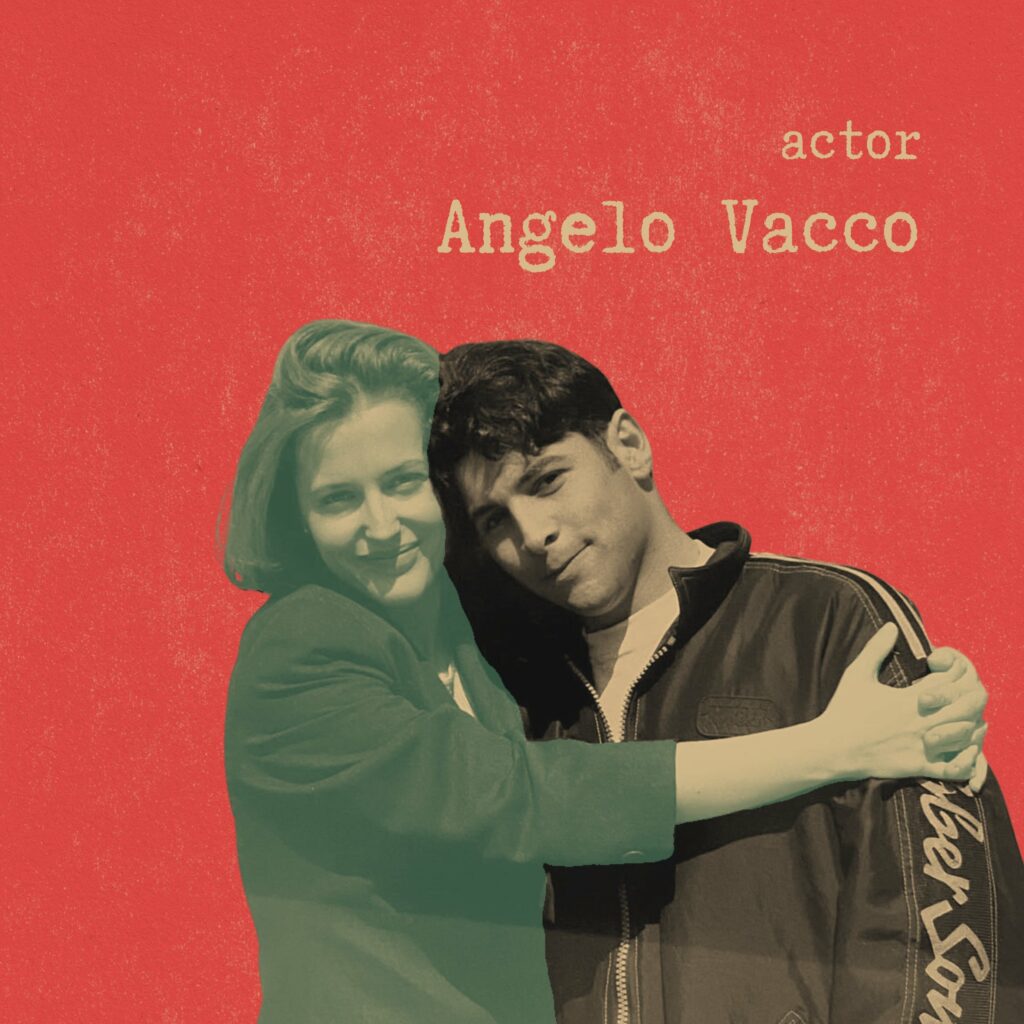
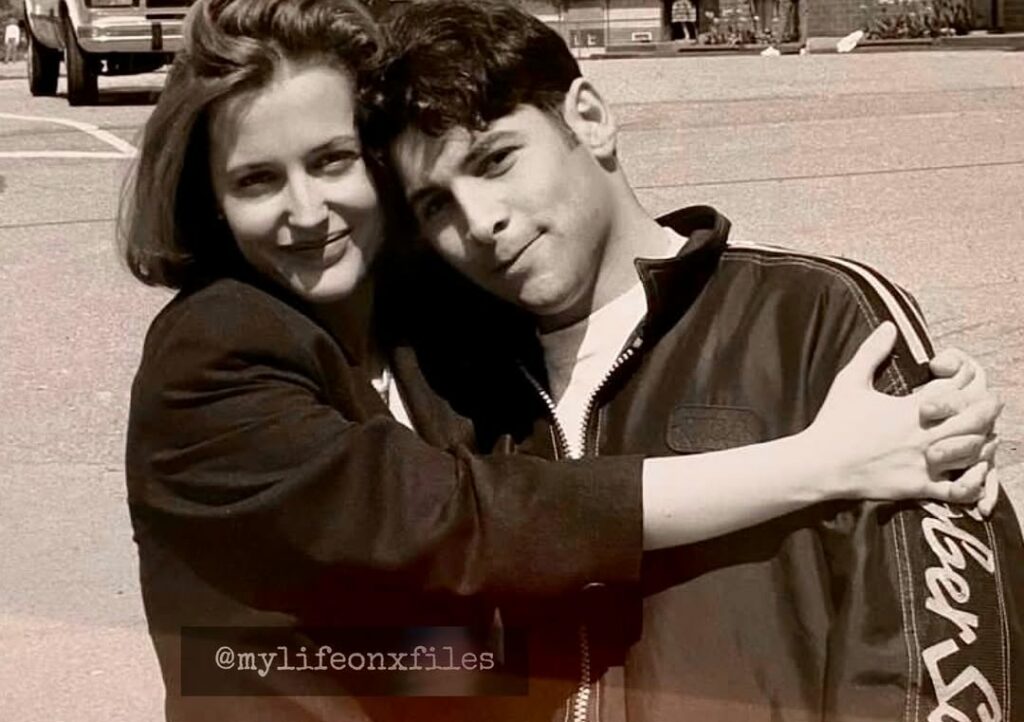
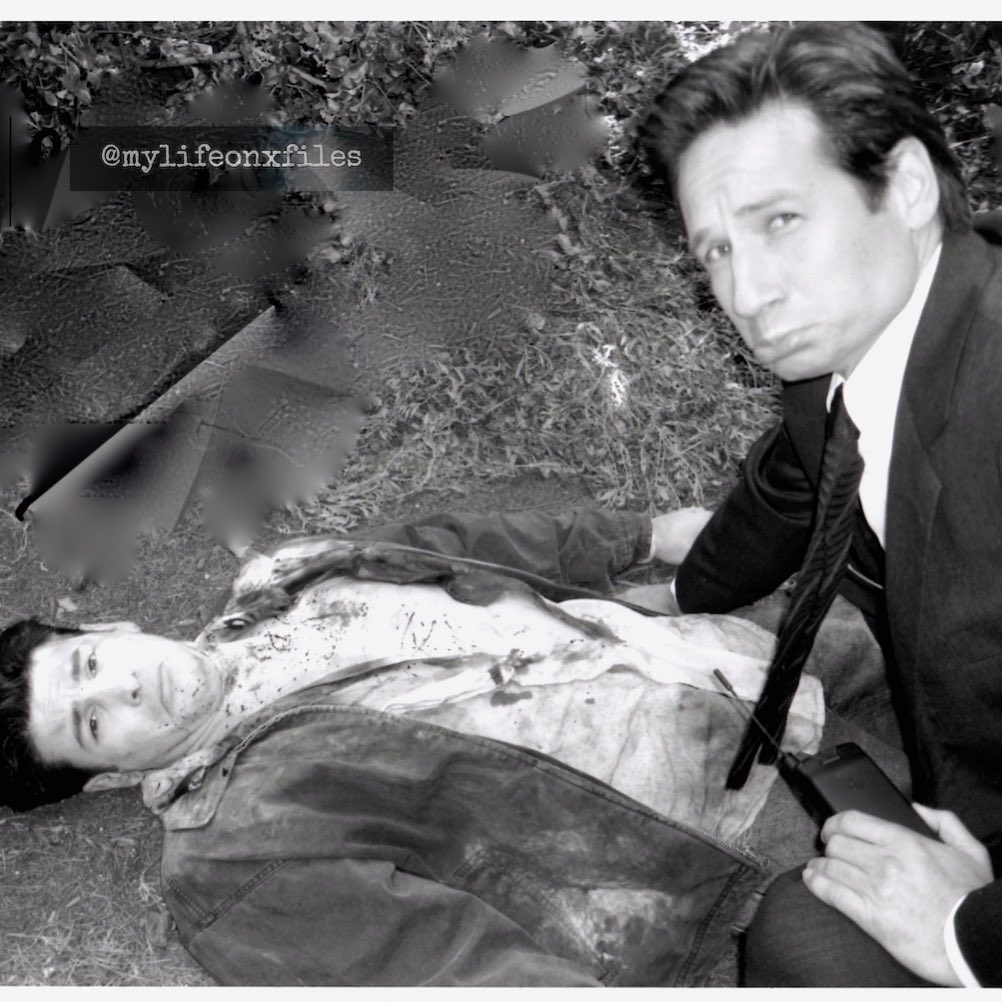
The “Hey Danny, it’s Mulder” podcast did a nice little interview with Angelo Vacco, who was a production assistant for nearly the entire run of The X-Files, plus he had small roles on the series: a gas station attendant in “F. Emasculata”, a victim in “Milagro”, plus a doorman in “Talitha Cumi” and a bartender in “Improbable”. He also holds an Instagram account with his own photos from the making of the show: “My Life on X-Files“!
Here are the cliff notes:
Fresh from New York to Los Angeles, he wanted to be an actor. He didn’t know TXF at all. He approached production between seasons 1 and 2, he was 22. On his very first day, Joan (Chris Carter’s assistant) told him he would be a “temporary production assistant”, in the LA offices.
Typical tasks would be to get coffees, make photocopies, distribute scripts, get dailies from Vancouver to be screened to the LA producers and executives. Wash Carter’s car.
Eventually the producers had to make a decision on him. Howard Gordon said “we have to keep Angelo”. He ended up staying for 8 seasons!
In the early years, the LA crew were few people. The editing was done in a movable trailer on the Fox lot. Building 49, Carter’s office, was an old 1920s bungalow. There was no space on the Fox lots.
Working on TXF was a dream job. They were a work family, doing 16-hour days.
He did photography, developed his own photos, and took a lot of photos while at work. Many of these can be seen on his Instagram, “My Life on X-Files”.
He met Carter when he was returning from shooting “Duane Barry” (the first episode he directed). The episode was initially named “Duane Garry” but they had to change it when they found there was a real FBI Agent named that. He asked if he could be an actor.
The “F. Emasculata” script reads about the gas station attendant, “he looks so much like Angelo Vacco we could swear it’s him”! So he didn’t audition for that role, but he did for the others.
The Vancouver pool of actors was small, so there was the “X-Files rep”, a répertoire of actors with repeat roles.
He auditioned for “D.P.O.”.
“Milagro” was shot in Griffiths Park. He did ADR on his own scream.
He has a lot of stories to tell about shooting the Bree Sharp music video for “David Duchovny, why won’t you love me?” song, where he is also credited. The video’s two directors were involved in Millennium (Will Shivers, uncredited?) and TXF (Charles/Chuck Forsch, assistant to Chris Carter and to the producers). It started as an end-of-season video made by the crew. Then Bree sent the song, it got to David. They did the music video on the Fox lot and hence got people like Brad Pitt (shooting Fight Club), Sarah Michelle Gellar (shooting Buffy), he drove around with the golf cart and just asked.
Angelo also works in ADR (automated dialogue recording) doing things like background conversations, voices of police officers on the radio, TV presenters. He has been doing work with the same ADR group for 25 years and he did ADR work for the TXF revival seasons
“Paul Rabwin knows everything” about making The X-Files. [somebody interview that man!]
Here’s a selection of Angelo’s photos, there’s much more on his account!
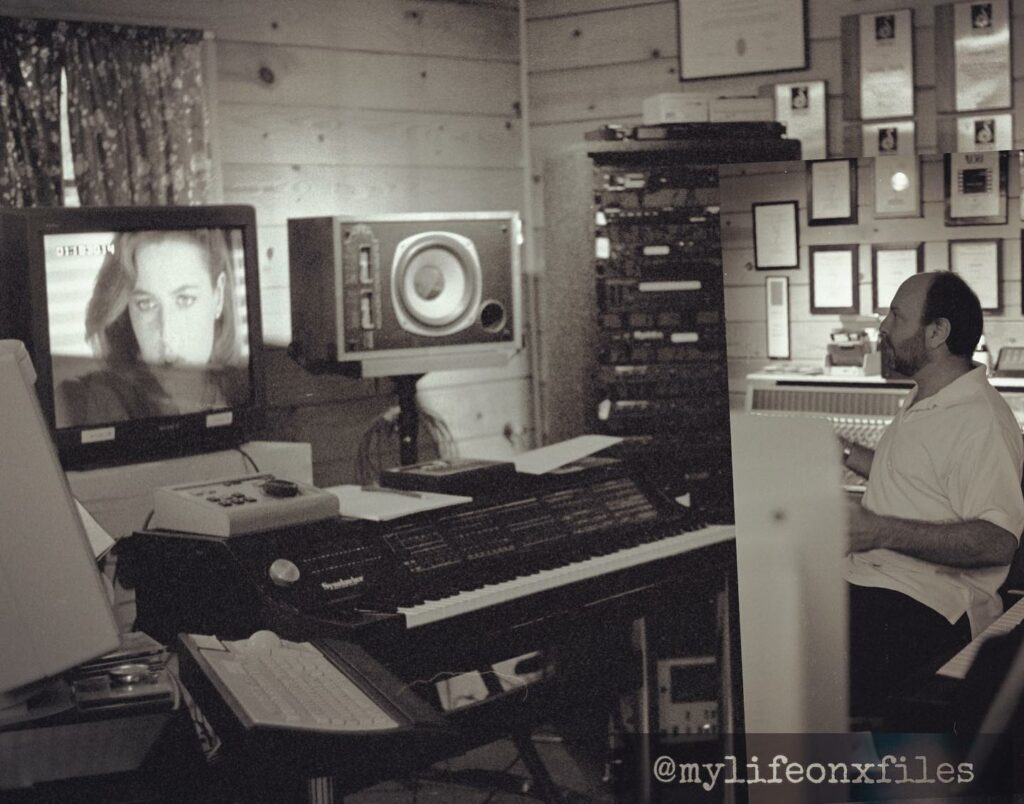
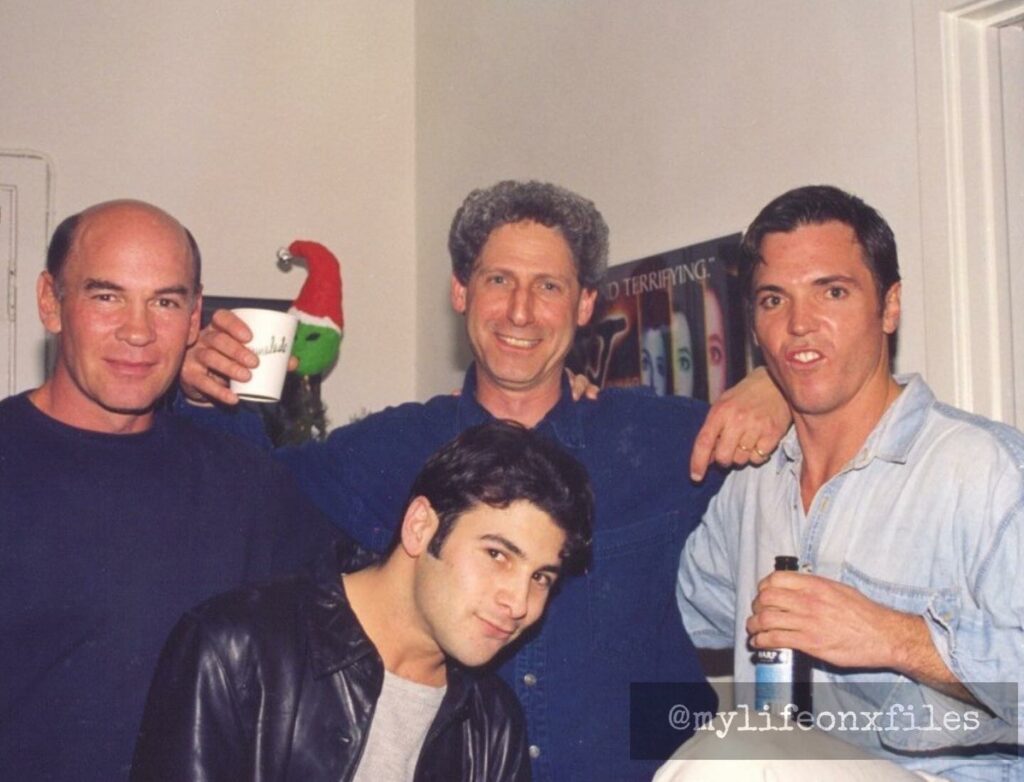
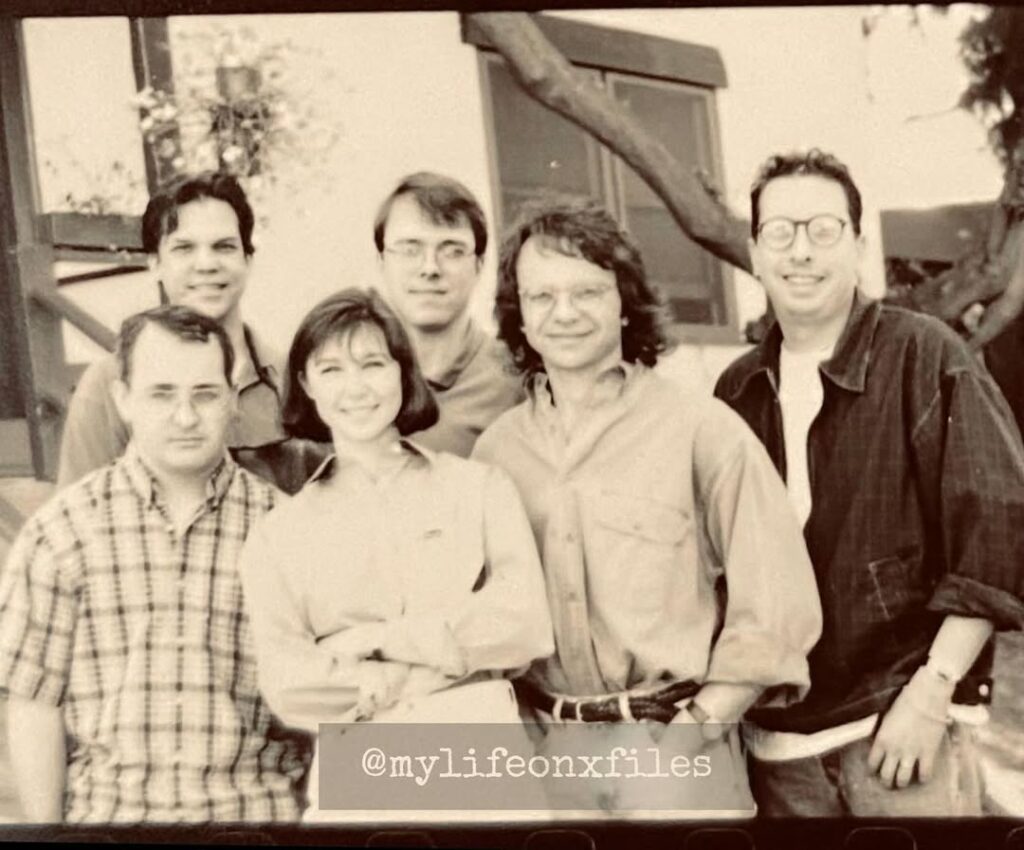
Shooting “Talitha Cumi”Shooting “Milagro”Mark Snow’s studioWith Mitch Pileggi, Thierry Couturier (sound editor), Nick LeaSeason 3 writers (Darin Morgan, Jeff Vlaming, Kim Newton, Vince Gilligan, Frank Spotnitz, John Shiban)
Here are the highlights from some recent interviews with Vince Gilligan, who really started his career with The X-Files in season 2.
Starting on TXF:
His agent Rhonda Gomez: “she said, “Yeah, I haven’t seen it [TXF] yet. But, actually, I’m related to the fellow who created [the show], related by marriage to his wife. Would you like to meet him the next time you’re out to California on movie business?” ” [Dori Pierson really, really helped Carter’s career!]
“They had a 26 [episode] order for the second season of X-Files, and they didn’t have enough episodes. They were taking any warm body who walked through the door.”
On Soft Light, his first episode:
Inspiration: “The night before [meeting Carter], I was sitting on the sofa in my hotel on Beverly [Boulevard]. I was watching TV, and the lights were off. I was looking at my shadow on the wall, and I thought, “Wouldn’t it be creepy if it started moving independently of me?” […] in the original version, this [shadow] was alive and it moved separately.”
Rewrites of the initial script: “If it had been produced as it was written, it would have cost somewhere — just for that one hour of TV — between $40 and $50 million.” “It was so big and over the top and insane and unproducible. And [the producers] took it — they said, “Thank you very much” — and then they rewrote, probably, 70%, 80% of it. They were very nice about sending me the script back after it had gone through the rewrite process.”
On Small Potatoes:
“I got to be on the set the whole time up in Vancouver, and I had the best time.”
“he [DD] really liked Darin, and he got to play Darin, essentially.”
On Bad Blood:
“I got to be on the set the whole time and I enjoyed it thoroughly.”
“Some of my favorite dialogue in “Bad Blood” is stuff I didn’t write. My favorite scene in “Bad Blood” is when David Duchovny and Luke Wilson were sitting in the cop car out by the cemetery and they just start riffing. Luke Wilson’s character is saying, “So the guy you’re looking for is kind of like Rain Man?” And David says, “No, not really.” And Luke goes, “Well that ol’ boy could count all those toothpicks.” All that dialogue in that sequence there, it was just David and Luke who came up with that. It makes me laugh so hard. I didn’t write a word of that.”
On X-Cops:
“I think it was one of their [DD/GA] favorites because that was the shortest shooting time of any episode of The X-Files. The X-Files typically took between 13 and 21 days to shoot an episode. But “X-Cops” was shot on video, and it was done in these long oners. That episode was shot in five or six days.”
“It was a big deal, for instance, as I recall, to shoot it on video, instead of shooting it on the normal 35mm Kodak stock that we shot the show on.”
“we shot with Bertram van Munster, who was a producer on Cops at the time […] He was one of their lead camera operators; he’d be the guy riding around with this big camcorder on his shoulder, riding around the back of these squad cars on Cops. He photographed a fair bit of the episode himself”
On writing and the humor in TXF:
“Darin Morgan showed everybody that The X-Files could, indeed, be funny, but I tend to think that Glen Morgan and Jim Wong don’t get enough credit. Really, the first little whiffs of humor, as I recall, were in episodes written by them. They had some killer lines between Mulder and Scully in certain early episodes.”
“I never really got to know either David or Gillian as well as I perhaps might’ve hoped to because they were busy on the set 14, 15 hours a day, and I was busy in my little cubbyhole, writing and rewriting episodes.”
“There was a lot of midnight oil being burned, trying to figure out how to get exposition across [in these episodes] in a way that didn’t seem expositional. One of the many things I learned working on The X-Files for seven years was, how little the audience needs explained to them. It took me years to learn that as a writer, but it was an invaluable lesson. And you don’t learn it just from writing many episodes of TV, you learn it from spending hours and hours in the editing room. You come to realize that there are whole reams of dialogue that you can cut out in an editing room — because the actors are so good.”
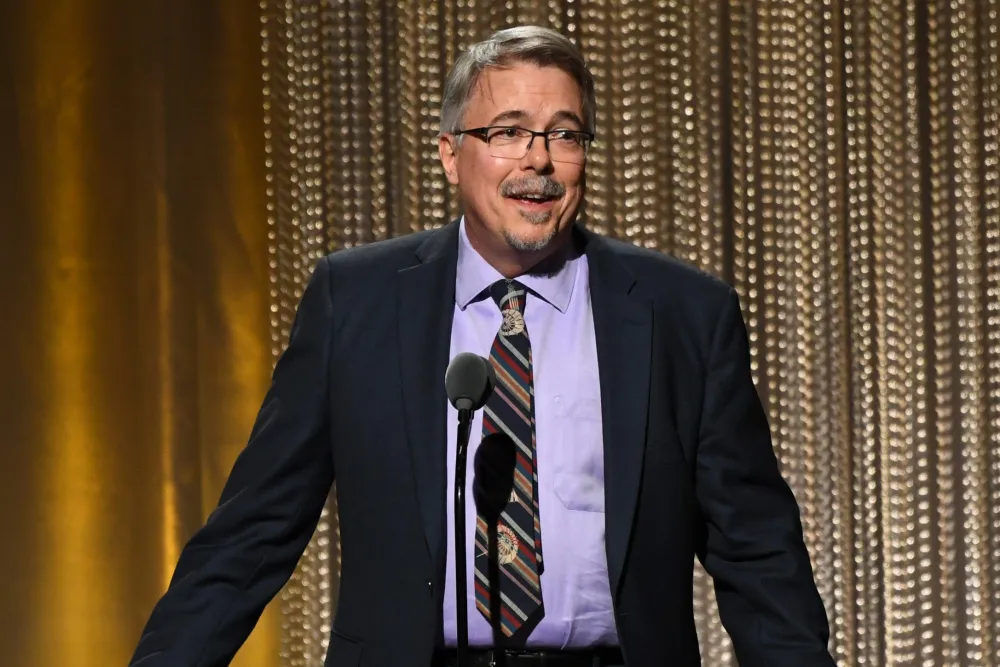
In his speech accepting a top award at the Writers Guild, Vince Gilligan — creator of iconic shows with anti-heroes like “Breaking Bad” and “Better Call Saul” — argued that the ‘bad guys as protagonists’ trend had gone too far, and he urged writers to come up with more shows where the leads are actually good guys. (Hear, hear!) Looking forward to his next show, then.
Introducing that award was Gillian Anderson, with a hilarious intervention (“we did some 7065 episodes in the 9000 years that we were shooting”)!…
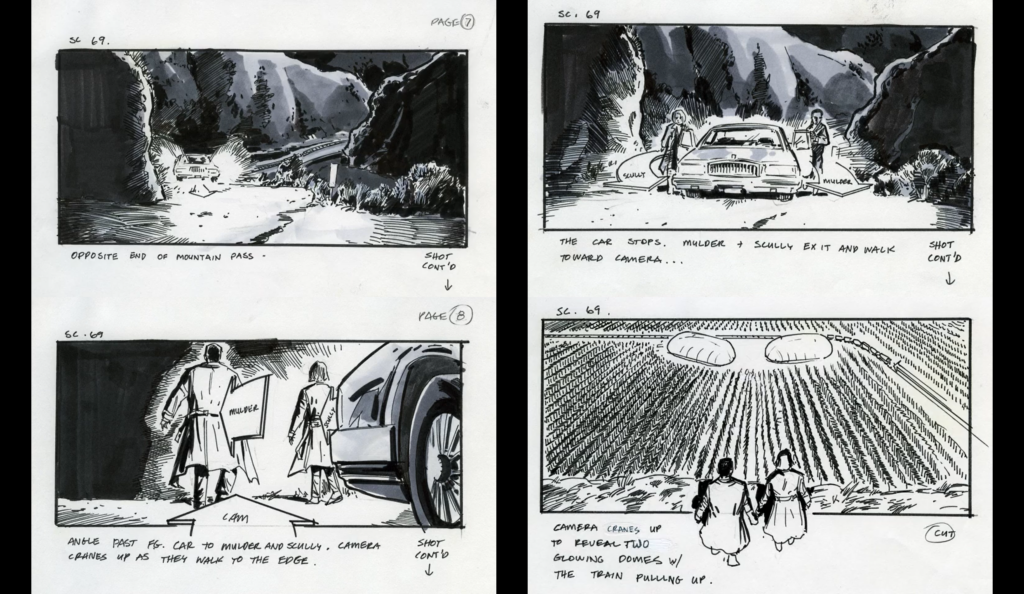
It’s The X-Files: “Fight The Future” Day! The movie premiered…27 years ago already. On that topic, here is an excellent and comprehensive interview with one person that was important in the making of that movie but that we had never heard of previously: storyboard artist Gabriel Hardman, who has had a very full career since! Courtesy of the “Hey Danny It’s Mulder” podcast.
Some notes and highlights:
He did pencilling for comic books. He started doing storyboards when the comic book industry contracted in the mid-1990s. As a huge “Twin Peaks” fan, he went to a book signing with Mark Frost; in the line, he met a guy, they almost collaborated in doing a CD-ROM of what would have been season 3 of “Twin Peaks” [wow TP fans are just as dedicated as TXF fans!]; he introduced him to who became his agent, and got him his X-Files job. He was just 22 years old, it was the first big movie he worked on. The recommendations he got from working on FTF were what got his career going.
In a bungalow in the Fox lot that became Carter & Bowman’s office for the whole shoot, he came in to read the script for what was then called “Blackwood“, it was printed on red paper. He was essentially the first person recruited, and was present for all the shooting until the very last day (not just for pre-production). Robb Bihun was the other storyboard artist.
He draws visual storyboards, including camera cues, lenses, movement of camera, the frame… He submits an idea to the director, who gives notes, he refines it, does another pass… The storyboards were updated as various design decisions were being made. Nobody could come up with a good design for the big ship at the end; production designer Chris Nowak told him to give it a shot, this is the drawing that is in the making of book. He learned a lot from director Rob Bowman, practical things about filmmaking, visual storytelling tricks and ideas, how to design shots interestingly and economically.
He had a good collaboration with director of photography Ward Russell — but it can be that there can be tension between storyboard artist and DP. The DP was who said it was OK for him to direct the second unit. [This was great that he was given this opportunity!] What he shot was with a helicopter, driving the car in the desert, coming to a stop on a crossroads — the shots without the actors.
He got along well with producer Dan Sackheim — stories about Dan having trouble unboarding a helicopter, and about Dan being stung by a bee! He flew to the glacier for location scouting. Going on location makes it specific, allows to adjust the storyboards. Shooting the hives scenes: they needed a wide lens to show the big space, but it was impossible to capture the small bees at the same time. The bees ended up being computer generated, the shooting was complicated by the bees that ended up not being needed.
Steven Spielberg’s “Close Encounters of the Third Kind” was a big visual influence: the shot of Mulder & Scully in the desert, pull out to reveal a road barricade; or the shot with kids going over a berm, revealing the secret base. There was going to be a car chase à la “French Connection” (Mulder after the ambulance that got Scully, instead of being shot in the head). The script specifically said “the car chase of Rob Bowman’s dreams”. But it got cut as there was too much in the movie already.
He still has the boards. They were pen & ink and grey marker on paper. The criterion was whether it could be photocopied and faxed well. For references for likenesses he only had some magazines and production photos — no internet, no computers.
About Carter: Carter stayed in a producer role, he didn’t get in Bowman’s way. Carl Sagan’s “The Demon-Haunted World” had just come out, and Carter was not thrilled, he thought Sagan got bitter at the end — it turns out 30 years later Sagan was correct. [That magnificent 1995 book about tending the fragile flame of scientific thought against lack of education and superstition came out shortly before Sagan died in 1996.]
Gabriel’s storyboards, in sequence, were included in the Blu Ray for the movie, the whole thing lasts for an hour and it’s like a mini-movie previsualisation itself! The intermediate level between script and what became the image that was captured by the camera.
Recently, the Millennium Group Sessions Redux podcast released two interviews that were conducted for the 25th anniversary of Millennium, which was in October 2021, so these are not quite recent intervews but they are newly released nevertheless. They make for some very interesting listening, Carter being his typical tight-lipped self and Spotnitz very well articulated.
If there’s one thing I’d highlight here is that Carter not only has (had?) high hopes for a Millennium revival, but that he has given thought to where the characters are and what the setting is, which…1) I want to know all about this! But also 2) How incredibly optimistic! Given how much time has passed, given how the XF revival was received, and given Frank Black’s age. I suppose it’s still possible with Jordan as the lead character, or as a complete reboot with a recast, but it’s quite a stretch.
Below, important quotes (made easy with automatically generated episode transcripts) [and my comments]:
Chris Carter
“[MM] actually maintained what I would call a solid audience through its three years. I think the show could have gone on, and for reasons that I regret, the show did not, but we had very solid ratings that could have carried us on.”
[On the 3 seasons] “I think of it as three different shows. I think of it as the first season. I think of it as the second season, when I had to step away. And I think of it as the third season, when we had to really respond to and answer to the second season, which was a departure. So I think the show benefited from that infusion of energy, and I think that, as I say, the fourth year and beyond would have been a very interesting continuation of something that I think still held a lot of promise and energy.” [Since this interview he has opened up that it was his call to cancel MM. We will be left wondering.]
[On handing over s2 to Morgan & Wong] “I don’t remember exactly what the hand-off constituted or what constituted a hand-off, but I know they had very strong feelings about the show, the characters, the relationships, and the storytelling.”
[IWTB and the rumour at the time that Frank Black would appear in it] “It’s funny, it has a Millennium theme to it, certainly a storytelling. The second movie was inspired by something that actually took place, and I met with a doctor in Cleveland at Case Western University who had actually conducted a head transplant on a chimp, and so that was kind of the inspiration. I don’t remember if Frank Black was going to appear in the movie or not, I’m not sure now looking back, he might have appeared in the movie. That said, I always look for any opportunity to feature Lance.” [He can’t recall for something as HUGE as Frank Black’s return? This is hard to believe.]
“You try to be an audience pleaser always, but you try to make sure that you are following your own instincts. Shows can be I think directed and misdirected by audience feedback. Looking at The X-Files, while we heard our audience, we were always true to the characters and the situations and the mythology, and I think the same could be said for Millennium.” [Completely agreed on both directed and misdirected by the audience.]
[Whether Peter Watts is actually dead or not?] “I actually can’t answer that question. It’s funny that in the season finale of the last reboot of The X-Files, Mitch Pileggi’s leg was the last thing you saw. So I think those are wonderful coincidences.”
[MM on streaming or Blu-Ray?] “I hope so, and I think so. I don’t know that it’ll come out on Blu Ray, which seems to be somewhat of a dying thing, but I think that it ultimately will find its way onto some platform, probably Hulu, which is owned by Disney/Fox.” [Still waiting.]
[TXF s10-11] “there’s a trick, and the trick is being respectful of the original fans, the fan base, people who have held the torch, but at the same time wanting to attract and entertain a new audience. With The X-Files that was the trick, we were responsible and receptive to fans’ desires to see the mythology and the stories within that mythology be continued, but at the same time we had to be mindful that we had a whole new audience.” [Nice insight — but whether he followed his own advice for the XF revival is up for debate.]
[A MM revival?] “If the show came back, I have some strong ideas about the direction of the show, the relationships, the characters, the situations, the circumstances, all those things are I think are have been on my mind.” [In typical Carter fashion, he doesn’t give us more — but it’s incredible that he has given it this much thought, he really thought there was a big chance for this to happen. Is this why he can’t answer whether Peter Watts is dead or not? It’s been 25 years! I think the boat has sailed, especially 4 years later after this interview. I hope he does open up eventually and will share these ideas with us.]
“Glen Morgan told me he had a meeting with some executives at a studio, I think it may have been Warner Brothers, and one of the executives says, if he had a show to bring back, it would be Millennium. Unfortunately Warner Brothers does not own the title, and so while that is always music to my ears it’s the wrong studio. That was recently.” [That’s impressive!]
[On continuing TXF without Gillian Anderson, possibly partnering Mulder and Frank Black in an episode] “I think that would be pretty cool. Actually, it’d be great crossover.” [That would have been very cool indeed.]
[On the TXF: Albuquerque animated show project] “I can tell you that, as it stands, that series is on the shelf, and for a variety of reasons I don’t think you’ll see it anytime soon, if you see it at all.”
[On what he’d do different in a MM revival] “You look at television now and people roll out 10-episode series, and we did 22 episodes a season roughly. […] I think I would look forward to doing a shorter run of the show and being able to write all the scripts before you ever went into production. […] It would be great to have the luxury of not writing while you’re producing and trying to stay one step ahead of this monster, this all-consuming monster who requires you to do way too many jobs at once. That would be a dream come true, and it would be make Millennium a better show.” [Good idea, although he still didn’t manage to do that with the 6 and 10 episode seasons of the XF revival, when he was still writing while shooting the episodes.]
[On offering Frank Spotnitz to run MM s2] “I had no idea about that. I don’t remember doing that. Frank was actively involved in The X-Files series and The X-Files movie. I think that would have been triple duty for him, so that actually is something I don’t recall. That may have been the case, but it has slipped my memory.” [see Spotnitz’s reaction below]
Frank Spotnitz
“the show didn’t reach the popularity of The X-Files, but the impact the show had on the people who saw it was really profound”
“Millennium was was really uncompromising in its way, and, honestly, I think that’s probably what limited the size of its audience, particularly in a network television landscape […] it was both what was great about it and also what probably kept it from being more popular than it was.”
“it was very much a movie type story every week”
[On his s1 episodes ‘Weeds’ & ‘Sacrament’] Weeds: “it was really about fathers and sons and the sins of the fathers being visited upon the sons” Sacrament: “in a very different way in Sacrament I kind of explored the same idea, which was not so much the sins of the fathers, but sort of the gifts of the fathers, if you will, the gift that Frank had and how that affected Jordan. But that’s an interesting theme to me, just generations and fathers and sons.”
“it’s one of those shows that we found as we went along, and that changed dramatically each of the three seasons. So I certainly had no idea from the first episode what the show was going to become, I don’t think anybody did.” “I think that that first hour is as good or better than anything Chris ever wrote, which is saying a lot, because Chris is such an incredible writer. I remember seeing it in a in a theater in Los Angeles because Fox so proud of it that they rented out theaters for the for the premiere, and just being absolutely blown away by it as a piece of filmmaking and a piece of television.” “we certainly didn’t know where the show was going to go, that it was going to ultimately embrace some supernatural elements.” “each season, it was like a triptych, each was a different way of seeing this world”
“the studio and the network were frightened by the show […] they could see that we were limiting the size of the audience by our uncompromising approach to the storytelling.” “the reason the show evolved is because we were eager to grow and not repeat ourselves, so I think there was this restless creative spirit that kept causing the show to reinvent itself.” “from the beginning of the first season, Chris sort of let go the original creative team and so he and I ended up doing double time on X-Files and Millennium that first season. And then obviously Glen and Jim came to the rescue in the second season, and then Chip and Ken in the third season.” [I don’t recall this about the original creative team, I wonder what happened.] “the third season, we all felt really proud of the show and what it did become, and we were pushing so hard for that fourth season that we ultimately didn’t get, I think because the network believed if they put something else in there, the ratings would grow, which turned out not to be true.”
[On being offered to run s2] “I was really flattered and grateful. But honestly, I don’t think I was ready at that point, and I certainly wasn’t ready to let go The X-Files either. So it was a tough call because I really did love Millennium, but I think I made the right call.” [I also think that was the right call, especially since we got Morgan & Wong’s s2, but I can’t help but wonder what would have happened to both MM s2+ and to TXF s5+ if Spotnitz had switched teams then.]
[On IWTB having some Millennium elements] “there’s a lot of truth to that. I think tonally it feels very much like Millennium, and it’s barely supernatural, so it could quite easily have fit into Millennium. But that’s where Chris’s head in particular was at at that point in time when we came back to The X-Files, he was more interested in the horror, psychological terror, and the thematic richness of it.”
[On the XF ‘Millennium’ episode] “we were so upset that Millennium didn’t get an ending that we were determined to give it an ending on The X-Files. I have to be honest, we didn’t appreciate how difficult that was going to be, because they are completely different shows, and we wrestled with that episode a lot. […] it was part of The X-Files, so it had to be an X-File first. I could totally get why some Millennium fans would be frustrated by that episode because it is more an X-Files episode than a Millennium episode. It’s an X-Files episode with Frank Black in it. […] it didn’t end up being the Millennium finale that we wanted it to be, but I couldn’t figure out how else to do it.”
[On Millennium compared to today’s television landscape] “X-Files and Millennium, to my mind, were both ahead of their time in terms of their cinematic ambition. In terms of the thematic element and the ambition of Millennium, it still gives all those [current] shows a run for their money, even twenty five years later, a lot of those shows don’t necessarily reach for the same complexity of theme and aren’t necessarily always as thought-provoking as Millennium was.” [Completely agreed, and that goes for all of Carter’s shows, it’s not ‘just’ good visuals or ‘just’ good plot, it’s a whole worldview, a philosophical stance.]
[Emma and Frank] “there was no social-cultural-racial agenda, it was like we loved Clea and what we thought she’d be bringing to the part and and that’s why we cast her, and I’m especially proud of that.”
“it was obviously influenced by Seven”
[About the three different seasons] “No, I don’t think it was a hindrance to the show at all. I think the show got as big an audience as it was always ever going to get, and it was creatively really strong and interesting all three seasons. […] What nobody realized in 1999 was that network television was already in decline, Fox [hoped to] recapture the X-Files numbers, which they never did. […] We were more a victim of changing viewership habits than of any creative mistakes or change of direction we may have made in the seasons.”
[On season 4 ideas] “I thought Chip [Johanessen] was going to do the fourth season and I think Chip really did have some ideas what he wanted to do. By the third season, it was not my show in any way at all. Chris and I would come in and make our contributions, but it was really Chip who was defining the show. I was really excited by what he was doing and was looking forward to, obviously, the actual millennium being on the show.”
“I really put my heart and soul into Millennium, like like I do all of these shows, and you do it because you’re hoping you’re going to reach other people. […] When people not only watch the show but like it enough to remember it and honor it and and keep it going for years, it’s incredible, I can’t tell you how gratifying that is.”